
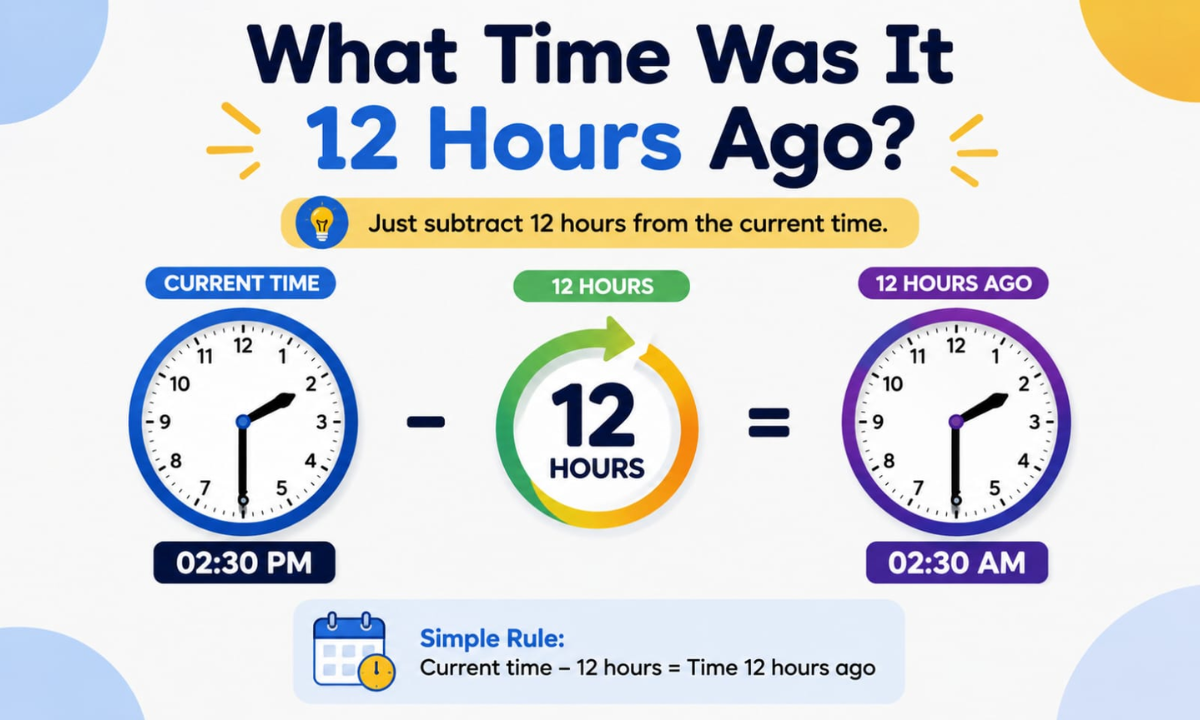
Wondering what time was it 12 hours ago? The simplest way to find the answer is to subtract 12 hours from your current time. Because 12 hours is exactly half of a 24-hour day, the clock usually shows the same hour and minutes but switches between AM and PM.
For example, if it is 4:30 PM now, 12 hours ago it was 4:30 AM. If it is 8:15 AM now, 12 hours ago it was 8:15 PM on the previous day. The main thing to watch is whether the calculation crosses midnight. Twelve hours equals 720 minutes or 43,200 seconds.
What Time Was It 12 Hours Ago?
To calculate the time 12 hours ago, subtract exactly 12 hours from the current time.
The easiest shortcut is:
Same clock time + opposite AM/PM
For example:
| Current Time | 12 Hours Ago | Day |
| 1:00 AM | 1:00 PM | Yesterday |
| 4:30 AM | 4:30 PM | Yesterday |
| 7:15 AM | 7:15 PM | Yesterday |
| 10:00 AM | 10:00 PM | Yesterday |
| 12:00 PM | 12:00 AM | Today |
| 2:30 PM | 2:30 AM | Today |
| 6:45 PM | 6:45 AM | Today |
| 9:20 PM | 9:20 AM | Today |
| 11:55 PM | 11:55 AM | Today |
Notice the important pattern: the hour and minutes stay the same, but AM becomes PM or PM becomes AM. The date changes when the backward calculation crosses midnight.
Understanding the Mathematics Behind Time Calculation
Twelve hours is exactly half of a 24-hour day.
The basic formula is:
Current Time − 12 Hours = Time 12 Hours Ago
You can also convert the duration into smaller units:
- 12 hours = 720 minutes
- 12 hours = 43,200 seconds
- 12 hours = 43,200,000 milliseconds
For example, suppose the current time is 6:25 PM.
Subtract 12 hours:
6:25 PM − 12 hours = 6:25 AM
The minutes remain 25 because you are subtracting a complete number of hours rather than minutes.
What Happens When You Cross Midnight?
Crossing midnight is the most important part of calculating 12 hours ago.
Suppose the current time is 5:00 AM. Going back 12 hours takes you to:
5:00 AM → 5:00 PM yesterday
The result is on the previous calendar day because midnight occurs between the current time and the calculated time.
Another example:
2:00 AM − 12 hours = 2:00 PM yesterday
This means the answer is not simply a different AM/PM label. You must also check the date.
A useful rule is:
If the current time is before noon, 12 hours ago was yesterday.
If the current time is noon or later, 12 hours ago was today.
This works for a standard 24-hour day and makes the date transition easier to remember.
Why AM and PM Switch Every Twelve Hours

The traditional 12-hour clock repeats the same numbers twice each day.
For example, the clock shows:
3:00 AM
and twelve hours later:
3:00 PM
Another twelve hours later:
3:00 AM
That is why subtracting 12 hours produces the same clock number with the opposite AM/PM designation.
The pattern is:
AM → 12 hours backward → PM
PM → 12 hours backward → AM
The minutes and seconds remain unchanged when the difference is exactly 12 hours.
What Time Was It 12 Hours Ago: Practical Examples
Here are several straightforward examples showing how the calculation works.
Example One
Current time: 8:00 PM
Subtract 12 hours:
8:00 PM − 12 hours = 8:00 AM
So, 12 hours ago it was 8:00 AM today.
Example Two
Current time: 9:30 AM
Subtract 12 hours:
9:30 AM − 12 hours = 9:30 PM yesterday
Because the calculation crosses midnight, the date moves back by one day.
Example Three
Current time: 12:15 PM
Subtract 12 hours:
12:15 PM − 12 hours = 12:15 AM
This is midnight at the beginning of the current day.
Example Four
Current time: 3:45 AM
Subtract 12 hours:
3:45 AM − 12 hours = 3:45 PM yesterday
The clock time remains 3:45, but AM changes to PM and the date moves backward.
Example Five
Current time: 11:50 PM
Subtract 12 hours:
11:50 PM − 12 hours = 11:50 AM
Because the starting time is already in the PM period, the result remains on the same calendar day.
Why People Search “What Was 12 Hours Ago From Now”
People search this question for many practical reasons. A past-time calculation can help establish when an event happened or determine the approximate timing of an activity.
Common reasons include:
- Checking an old message or notification
- Reviewing an activity timestamp
- Tracking work or study sessions
- Understanding when an event occurred
- Reviewing a schedule
- Checking travel times
- Comparing international activities
- Reconstructing a timeline
For example, if someone remembers that an event happened 12 hours ago, calculating the exact time can quickly turn that vague reference into a specific clock time.
Read This: What Time Was It 5 Hours Ago? Calculate the Exact Time
The Role of Time Zones
Time zones become important when the calculation involves people or events in different locations.
Twelve hours is always a 12-hour duration, but the displayed local clock time depends on the time zone.
For example, a timestamp may be recorded in UTC while your device displays local time. A calculator may also use your browser’s local time zone or allow you to select another location.
This matters for:
- International meetings
- Flight schedules
- Remote work
- Online events
- Gaming servers
- Global business operations
When checking a historical timestamp, confirm both the time and time zone before drawing conclusions.
Using Online Time Calculators
An online time calculator can determine the exact time 12 hours ago automatically.
Most calculators work by taking the current date and time, subtracting a 12-hour duration, and displaying the resulting date and time. Some also provide 12-hour and 24-hour formats, seconds, time-zone information, or a custom starting point.
A typical calculation involves:
- Entering or detecting the starting time.
- Selecting 12 hours.
- Choosing the ago/subtract option.
- Calculating the result.
- Checking the resulting date and time.
Online tools are particularly useful when seconds, dates, or time zones need to be precise.
Human Perception of Time

People do not always experience time in the same way that a clock measures it.
Twelve hours can feel very short when you are busy, traveling, sleeping, or enjoying an activity. The same 12 hours can feel much longer when you are waiting or watching the clock.
However, the mathematical duration never changes:
12 hours = 720 minutes = 43,200 seconds
For exact records, digital timestamps and time calculators are more reliable than memory or personal estimates.
What Time Was It 12 Hours Ago in the 24-Hour Clock?
The 24-hour clock makes the calculation especially easy.
Simply subtract 12 from the hour. If the result becomes negative, add 24 and move to the previous day.
For example:
18:30 − 12 hours = 06:30
So:
6:30 PM → 6:30 AM
Another example:
08:15 − 12 hours = -03:45
Because the result is below zero, add 24 hours:
20:15
Therefore:
8:15 AM today → 8:15 PM yesterday
The 24-hour format is useful for schedules, transportation, digital systems, and international communication.
Common Mistakes People Make When Subtracting 12 Hours
Several simple mistakes can produce an incorrect answer.
Forgetting the Date Changes
If the current time is before noon, 12 hours ago generally falls on the previous calendar day.
Mixing Up Noon and Midnight
12:00 AM = midnight
12:00 PM = noon
Confusing these two can completely change the result.
Changing the Minutes
When subtracting exactly 12 hours, the minutes stay the same. For example, 7:42 PM becomes 7:42 AM.
Ignoring Time Zones
A timestamp from another country or system may use a different time zone than your local clock.
These mistakes are easy to avoid once you understand the basic 12-hour cycle.
Real-Life Situations Where Knowing 12 Hours Ago Matters
Work Schedules
Employees and managers may use 12-hour calculations when reviewing shift changes, handovers, attendance records, or overnight work periods.
Travel Planning
Travel schedules can involve long periods between departures and arrivals. Subtracting 12 hours can help establish an earlier point in the itinerary, but the relevant local time zone must also be checked.
Reviewing Security Footage
Security systems may record exact timestamps. Knowing what time was 12 hours ago can help locate the correct section of recorded footage.
Medication Reminders
A 12-hour calculation can help understand the timing between scheduled events, but medication instructions should always be followed according to the prescribed schedule or product directions rather than relying on a general time calculation.
Online Gaming and Events
Online games, livestreams, tournaments, and digital events may use timestamps to identify when an activity occurred. A 12-hour calculation can help translate a relative time reference into a clock time.
A Simple Formula to Remember
The easiest formula is:
Time 12 Hours Ago = Current Time − 12 Hours
For a quick mental calculation, remember:
Same hour + same minutes + opposite AM/PM
For example:
10:20 AM → 10:20 PM yesterday
10:20 PM → 10:20 AM today
The only additional step is checking whether the date changes.
Examples Using Everyday Times
| Current Time | 12 Hours Ago | Date |
| 12:10 AM | 12:10 PM | Yesterday |
| 2:25 AM | 2:25 PM | Yesterday |
| 5:40 AM | 5:40 PM | Yesterday |
| 8:15 AM | 8:15 PM | Yesterday |
| 11:55 AM | 11:55 PM | Yesterday |
| 12:30 PM | 12:30 AM | Today |
| 3:45 PM | 3:45 AM | Today |
| 6:20 PM | 6:20 AM | Today |
| 9:05 PM | 9:05 AM | Today |
| 11:35 PM | 11:35 AM | Today |
This table demonstrates the central pattern: 12 hours backward switches the AM/PM period while preserving the clock’s hour and minute.
What About Seconds and Milliseconds?

The same principle applies to seconds and milliseconds.
If the current time is:
7:24:36 PM
then 12 hours ago it was:
7:24:36 AM
The seconds remain 36.
Twelve hours equals:
43,200 seconds
and:
43,200,000 milliseconds
Therefore, when the calculation subtracts exactly 12 hours, the smaller time units remain unchanged unless you are also subtracting additional minutes, seconds, or milliseconds.
Why Time Feels Different Than It Really Is
Time perception is subjective, but clock time is objective.
A busy afternoon may seem to pass quickly, while waiting for an important event can make a few minutes feel much longer. Sleep can also make several hours seem to pass almost instantly.
Regardless of how time feels, 12 hours always represents the same mathematical duration.
Understanding this distinction is useful when comparing human memory with precise timestamps, digital records, calendars, and automated time calculations.
Conclusion
Finding what time was it 12 hours ago is usually a simple calculation. Subtract 12 hours from the current time, keep the minutes and seconds unchanged, and switch AM to PM or PM to AM.
The most important detail is the date. If the calculation crosses midnight, the answer belongs to the previous day. Noon and midnight also deserve special attention because they can easily cause confusion.
For everyday questions, mental math is usually enough. When exact timestamps, time zones, seconds, or historical records matter, an online time calculator can provide a useful verification.
Once you understand the 12-hour clock cycle, calculating the time 12 hours ago becomes quick, predictable, and easy.
Frequently Asked Questions
What time was it 12 hours ago?
Subtract 12 hours from your current time. The clock hour and minutes remain the same while AM and PM switch.
How many minutes ago is 12 hours?
Twelve hours equals 720 minutes.
How many seconds ago is 12 hours?
Twelve hours equals 43,200 seconds.
Does 12 hours ago mean yesterday?
Not always. If the current time is before noon, 12 hours ago was generally yesterday; if it is noon or later, it was today.
What was 12 hours ago from 8 AM?
Twelve hours before 8:00 AM was 8:00 PM yesterday.
What was 12 hours ago from 8 PM?
Twelve hours before 8:00 PM was 8:00 AM today.
What was 12 hours ago from midnight?
Twelve hours before 12:00 AM was 12:00 PM the previous day.
What was 12 hours ago from noon?
Twelve hours before 12:00 PM was 12:00 AM today.
Do the minutes change when subtracting 12 hours?
No. When exactly 12 hours are subtracted, the minutes and seconds remain the same.
Does the time zone affect the calculation?
The 12-hour duration stays the same, but the displayed local time can differ depending on the time zone used.
Can I calculate 12 hours ago manually?
Yes. Subtract 12 hours, switch AM and PM, and check whether the date needs to move to the previous day.
Is 12 hours half a day?
Yes. A standard 24-hour day contains two 12-hour periods, making 12 hours exactly half a day.

Eliana is an English language writer with 10 years of experience. She creates simple grammar guides, vocabulary tips, and writing resources for GrammerMint readers.