
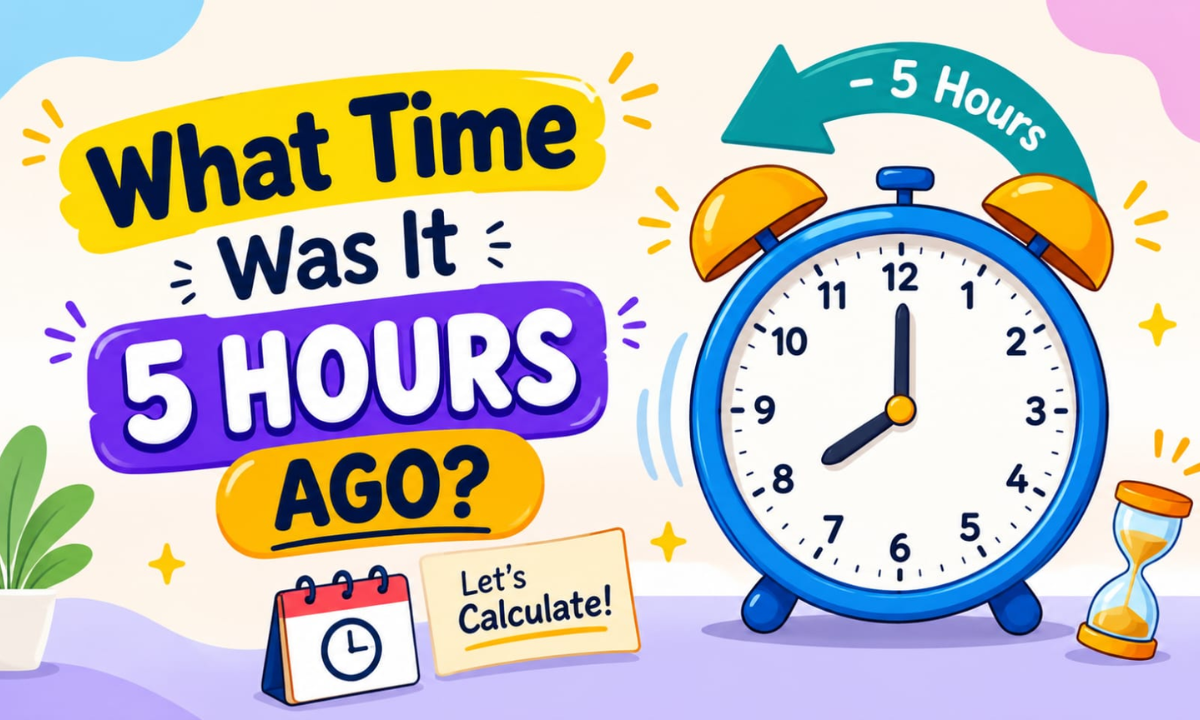
Wondering what time was it 5 hours ago? The answer is simple: subtract five hours from your current time. For example, if it is 8:00 PM now, five hours ago it was 3:00 PM.
Five hours equals 300 minutes or 18,000 seconds, so the calculation is straightforward in most situations. The only part that can make it confusing is when the calculation crosses midnight, changes the date, or involves different time zones.
Understanding What Time Was It 5 Hours Ago
To find out what time it was five hours ago, simply move the clock backward by five hours.
For example:
| Current Time | Time 5 Hours Ago |
| 6:00 AM | 1:00 AM |
| 8:00 AM | 3:00 AM |
| 10:00 AM | 5:00 AM |
| 12:00 PM | 7:00 AM |
| 2:00 PM | 9:00 AM |
| 5:00 PM | 12:00 PM |
| 8:00 PM | 3:00 PM |
| 10:00 PM | 5:00 PM |
| 12:00 AM | 7:00 PM yesterday |
The minutes and seconds stay the same when you subtract exactly five whole hours. For example, 9:42 PM minus 5 hours = 4:42 PM.
How Time Subtraction Actually Works

The basic formula is:
Current Time − 5 Hours = Time 5 Hours Ago
Suppose the current time is 4:30 PM.
Subtract five hours:
4:30 PM − 5 hours = 11:30 AM
The minutes remain at 30 because you are only changing the hour.
Five hours can also be expressed as:
- 5 hours
- 300 minutes
- 18,000 seconds
- 0.2083 days
These conversions are useful when working with digital timestamps, schedules, timers, or detailed time calculations.
Why Reverse Time Calculation Matters in Everyday Life
Knowing what time it was several hours ago is more useful than it may initially seem. People regularly need to work backward from the present to understand when something happened.
Common examples include:
- Checking when a task was completed
- Reviewing work or study sessions
- Understanding activity timestamps
- Tracking travel schedules
- Reconstructing an event timeline
- Checking when a message or notification arrived
- Calculating employee shift periods
- Reviewing gaming or streaming sessions
A simple five-hour calculation can help establish a more accurate timeline without requiring a complicated date calculator.
What Time Was It 5 Hours Ago Using the 12-Hour Clock
The 12-hour clock divides the day into AM and PM.
When subtracting five hours, make sure you keep track of whether the result falls in the morning or afternoon.
For example:
Current time: 6:00 PM
Move backward five hours:
6 PM → 5 PM → 4 PM → 3 PM → 2 PM → 1 PM
Therefore:
5 hours ago = 1:00 PM
Another example:
Current time: 3:00 AM
Move backward five hours:
3 AM → 2 AM → 1 AM → 12 AM → 11 PM → 10 PM yesterday
The last example crosses midnight, so the date changes as well.
What Time Was It 5 Hours Ago Using the 24-Hour Clock
The 24-hour clock can make subtraction easier because it removes AM and PM labels.
For example:
18:00 − 5 hours = 13:00
So:
6:00 PM = 18:00
and:
5 hours ago = 1:00 PM
Another example:
03:00 − 5 hours
Because 03:00 is less than five hours, move backward across midnight:
03:00 → 22:00
The result is 22:00 on the previous day, or 10:00 PM yesterday.
Using a 24-hour clock is particularly helpful for digital systems, transportation schedules, international communication, and time records.
Crossing Midnight: The Most Common Mistake
Crossing midnight is one of the easiest ways to make a reverse-time calculation incorrectly.
Suppose the current time is:
2:00 AM
Five hours earlier is not 9:00 AM on the same day. You must move backward through midnight:
2:00 AM → 1:00 AM → 12:00 AM → 11:00 PM → 10:00 PM → 9:00 PM
Therefore:
5 hours ago = 9:00 PM yesterday
The important rule is:
If subtracting hours takes you before midnight, the result belongs to the previous calendar day.
This distinction matters when recording events, checking timestamps, or reconstructing a sequence of activities. Time calculators also account for date transitions automatically.
Read This: How Long Until 2:45 PM? Calculate the Exact Time Remaining Today
Manual Time Arithmetic Without a Calculator

You do not need an online tool to calculate five hours ago.
Follow these simple steps:
- Look at the current hour.
- Subtract 5 from the hour.
- Keep the minutes and seconds unchanged.
- If the calculation goes below midnight, move to the previous day.
- Convert the result to AM or PM if using the 12-hour clock.
Example 1
Current time: 7:45 PM
Subtract five hours:
7:45 PM − 5 hours = 2:45 PM
Example 2
Current time: 11:20 AM
Subtract five hours:
11:20 AM − 5 hours = 6:20 AM
Example 3
Current time: 3:15 AM
Subtract five hours:
3:15 AM − 5 hours = 10:15 PM yesterday
This method works quickly for most everyday calculations.
Using Online Time Calculators
An online time calculator can provide the answer instantly without requiring mental arithmetic.
Most time calculators allow you to enter a number such as 5, select hours, and choose ago or subtract. The tool then calculates the corresponding time and may also show the date.
Some calculators provide additional features such as:
- 12-hour and 24-hour displays
- Exact seconds
- Date transitions
- Custom starting times
- Time-zone comparisons
- Timeline views
- Multiple time-unit conversions
These features are useful when the calculation needs to be precise rather than simply approximate.
Time Zones Make Everything More Interesting
The phrase “five hours ago” is based on a specific starting time and time zone.
For example, two people in different countries can look at their clocks at the same moment and see completely different local times. If each person subtracts five hours from their own local clock, they will receive different clock readings even though both calculations are correct.
This matters when dealing with:
- International meetings
- Remote teams
- Flight schedules
- Global events
- Online gaming
- Social media timestamps
- Customer support records
Some time calculators display results across multiple time zones, making it easier to compare the same moment around the world.
Real-Life Examples of Five-Hour Calculations
Here are some common situations where calculating five hours backward can be useful.
| Situation | Current Time | Five Hours Earlier |
| Morning work | 11:00 AM | 6:00 AM |
| Afternoon appointment | 3:30 PM | 10:30 AM |
| Evening event | 7:15 PM | 2:15 PM |
| Late-night activity | 11:45 PM | 6:45 PM |
| Early morning | 2:30 AM | 9:30 PM yesterday |
These examples show why the date should always be checked when the calculation passes midnight.
Medication Timing
Time calculations can sometimes be used to understand when a previous dose or scheduled event occurred. However, medication schedules should follow the instructions provided by a qualified healthcare professional or the medication label rather than relying on a simple “hours ago” calculation.
For general record-keeping, if an event occurred at 8:00 PM and you need to identify five hours earlier:
8:00 PM − 5 hours = 3:00 PM
For actual medication decisions, the prescribed schedule takes priority.
Flight Timing
Air travel frequently involves different time zones, making reverse time calculations more complicated.
For example, a flight timestamp might be displayed in the departure city’s local time while another schedule uses the arrival city’s time. Subtracting five hours is only accurate if you are working within the same time reference.
Always check whether a flight time is:
- Local airport time
- UTC
- Departure time
- Arrival time
- Scheduled time
- Actual time
This prevents confusion when reconstructing travel timelines.
Shift Calculation
Employees, managers, and businesses may use reverse-time calculations to understand when a work period began.
For example, if a task was completed at 6:00 PM after a five-hour work period, moving backward five hours gives:
6:00 PM − 5 hours = 1:00 PM
This can help with basic schedule reviews, although official attendance or payroll records should be used whenever exact employment records are required.
Memory Reconstruction
Sometimes you remember an event only in relation to the current time.
For example, you might remember:
“That happened about five hours ago.”
If the current time is 9:00 PM, the approximate event time would be:
4:00 PM
For a precise reconstruction, however, check timestamps, messages, photos, receipts, calendar entries, or other records instead of relying entirely on memory.
Gaming
Gaming sessions often involve timestamps, match histories, server events, or activity logs.
If a game shows that an event happened five hours ago and your current time is 10:00 PM, the event occurred around:
5:00 PM
For online games with international servers, the displayed timestamp may use a server time zone rather than your local time, so always check the time reference.
Human Perception Versus Digital Precision

People often estimate time differently from clocks and computers.
Five hours can feel surprisingly short during an engaging activity and surprisingly long when waiting. This is why human memory is not always reliable for exact timestamps.
Digital clocks and time calculators can provide much greater precision, especially when seconds matter.
For example:
10:37:42 PM − 5 hours = 5:37:42 PM
The exact seconds remain unchanged when subtracting precisely five hours.
Tips for Accurate Reverse Time Calculation
Use these simple rules to avoid mistakes:
- Start with the exact current time.
- Subtract five hours rather than estimating.
- Keep the minutes and seconds unchanged.
- Watch carefully for midnight.
- Change the date when crossing into the previous day.
- Confirm the time zone for international calculations.
- Use 24-hour time when AM/PM becomes confusing.
- Use a calculator when seconds or dates are important.
- Check timestamps when reconstructing past events.
The biggest mistake is usually forgetting that a result can belong to yesterday, especially when the current time is shortly after midnight.
Conclusion
Finding what time was it 5 hours ago is usually a simple matter of subtracting five hours from the current time. Five hours equals 300 minutes, so the same calculation can also be performed using minutes when necessary.
The main complication occurs when the calculation crosses midnight or involves different time zones. In those situations, you need to account for the previous date or the relevant local clock.
Whether you are checking a work schedule, reviewing an event, looking at a timestamp, or simply satisfying your curiosity, a quick reverse-time calculation can give you the answer in seconds.
For ordinary calculations, mental math is enough. For precise dates, seconds, or international time zones, an online time calculator provides a convenient way to verify the result.
Frequently Asked Questions
What time was it 5 hours ago?
Subtract five hours from your current time. For example, if it is 8:00 PM now, it was 3:00 PM five hours ago.
How many minutes are in 5 hours?
Five hours equals 300 minutes.
How many seconds are in 5 hours?
Five hours equals 18,000 seconds.
What time was it 5 hours ago from 10 PM?
If it is 10:00 PM now, five hours ago it was 5:00 PM.
What time was it 5 hours ago from 3 AM?
Five hours before 3:00 AM is 10:00 PM on the previous day.
Does the date change when calculating 5 hours ago?
Yes, if subtracting five hours crosses midnight, the result falls on the previous calendar day.
How do I calculate 5 hours ago manually?
Subtract 5 from the current hour while keeping the minutes and seconds unchanged, then adjust the date if you cross midnight.
What is 5 hours ago in 24-hour time?
Simply subtract 5 from the current 24-hour time. For example, 18:00 becomes 13:00.
Can an online calculator find the exact time 5 hours ago?
Yes. Many time calculators automatically subtract five hours and display the resulting time and date.
Does time zone affect the answer?
Yes. The exact clock time depends on the time zone associated with the current time and the event being calculated.

Eliana is an English language writer with 10 years of experience. She creates simple grammar guides, vocabulary tips, and writing resources for GrammerMint readers.