
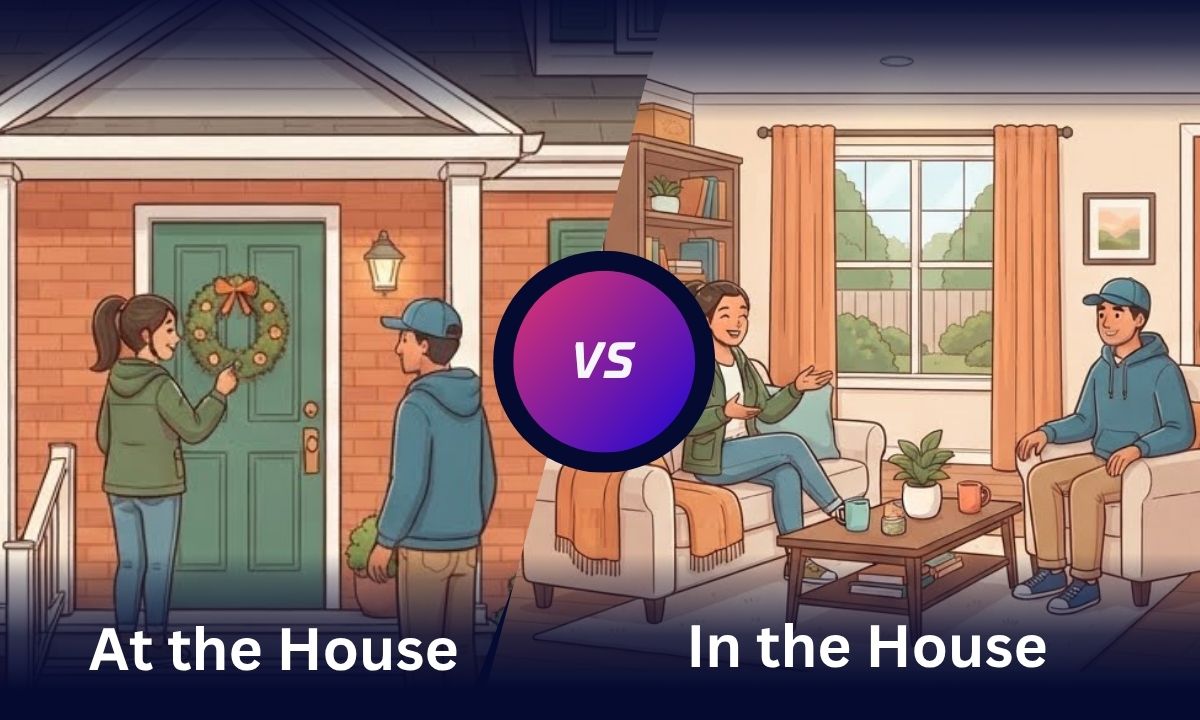
Many English learners are confused about at the house and in the house because both phrases are correct. The difference is not about grammar. It is about the meaning you want to express. Choosing the wrong preposition can make your sentence sound unnatural.
The good news is that the rule is simple. At the house usually refers to a location or destination, while in the house means someone or something is inside the building. This guide explains the difference with easy rules, real examples, and common mistakes.
Quick Answer: At the House vs In the House Meaning
Here is the short answer.
- At the house means someone is at the location or property.
- In the house means someone or something is inside the building.
Examples:
- I am at the house waiting for you.
- I am in the house watching television.
Both sentences are correct, but they describe different situations.
Why People Get Confused With At the House vs In the House
The confusion happens because both phrases refer to the same place but from different viewpoints.
English uses prepositions to describe location more precisely.
- At focuses on the place or destination.
- In focuses on being inside an enclosed space.
Since many languages use only one preposition in similar situations, learners often mix them up.
House vs Home: The Hidden Layer Most People Miss

Another reason for confusion is the difference between house and home.
A house is the physical building.
A home is the place where someone lives and feels comfortable.
Examples:
- Their house has three bedrooms.
- I cannot wait to go home.
Although people sometimes use the words interchangeably, their meanings are slightly different.
What Does At the House Mean in Real English Usage?
At the house means someone is at the location, property, or address. The person may be inside, outside, or somewhere on the property.
Common Meanings Include
- Being at a location
- Visiting someone
- Arriving at a destination
- Waiting outside or nearby
- Referring to a property
Examples in Real Situations
- I am at the house now.
- The plumber is at the house.
- We arrived at the house before sunset.
- The police are at the house.
Mini Real Life Scenario
Friend: Where are you?
You: I am at the house. I will come inside in a minute.
Here, the speaker has reached the location but is not necessarily inside the building.
What Does In the House Mean in Real Usage?
In the house means someone or something is physically inside the building.
Core Meaning
Being within the walls of the house.
Examples
- Everyone is in the house.
- The dog is in the house.
- She stayed in the house because it was raining.
- There is no electricity in the house.
Real Life Scenario
Mom: Where is your brother?
Child: He is in the house doing his homework.
The meaning is clear because the person is inside the building.
Core Grammar Rule Behind At vs In
The easiest way to remember the difference is this.
- At shows a point or location.
- In shows something inside an enclosed place.
Simple Mental Model
Think of at as arriving at the destination.
Think of in as entering the building.
This simple idea works in most situations.
At the House vs In the House in Real Life Scenarios

Scenario: Visiting a Friend
Before entering:
- I am at your house.
After entering:
- I am in your house.
Scenario: Delivery Driver
- The driver is at the house with your package.
The sentence focuses on the location.
Scenario: Emergency Situation
- Everyone stayed in the house until help arrived.
The sentence focuses on people being inside the building.
Common Collocations and Natural Usage Patterns
Common Phrases With “At the House”
- At the house now
- Meet me at the house
- Waiting at the house
- Arrive at the house
- Stay at the house
Common Phrases With “In the House”
- In the house all day
- Inside the house
- Sleeping in the house
- Nobody in the house
- Living in the house
Natural Speech Insight
Native speakers choose the preposition based on whether they are talking about the location or the inside of the building.
Quick Comparison Table: At the House vs In the House
| At the House | In the House |
| Focuses on location | Focuses on being inside |
| May be inside or outside | Definitely inside |
| Used for arrival and destination | Used for position inside the building |
| Common with visits | Common with activities indoors |
Common Mistakes People Make
Mistake 1: Using “In the House” Too Early
Incorrect
- I just arrived in the house.
If you have only reached the property, say:
- I just arrived at the house.
Mistake 2: Overusing “At the House”
If you are talking about activities inside the building, use in the house.
Correct
- We are eating in the house.
Mistake 3: Ignoring Context
Choose the preposition based on the situation.
Location equals at.
Inside the building equals in.
American vs British English Usage
American English
American English commonly uses both expressions with the same basic meanings.
British English
British English follows the same grammar rules.
Shared Rule
Whether you use American or British English, at refers to the location and in refers to being inside.
Subtle Nuances Most Learners Never Notice
Emotional Distance
At the house sounds more neutral because it focuses on the location.
Communication Speed
People often say:
- I am at the house.
This quickly tells someone where they are.
Implied Action
In the house suggests the person has already entered the building.
Easy Memory Trick That Actually Works
Ask yourself one simple question.
Am I talking about the location or the inside?
If the answer is the location, use at.
If the answer is inside the building, use in.
This simple trick works almost every time.
Mini Case Study: Real Conversation Breakdown
Phone Call
Alex: Where are you?
Sam: I am at the house.
A few minutes later.
Alex: Are you inside?
Sam: Yes. I am in the house now.
The first answer describes the location.
The second answer describes being inside.
When to Use “At the House”
Use at the house when talking about:
- Arriving
- Visiting
- Waiting
- Meeting someone
- Referring to a location
When to Use “In the House”
Use in the house when talking about:
- Being inside
- Living there
- Doing activities indoors
- People or objects inside the building
“At the House” vs “In the House” Usage Comparison
| Situation | Correct Expression |
| Waiting outside | At the house |
| Visiting a friend | At the house |
| Watching television indoors | In the house |
| Sleeping indoors | In the house |
| Talking about a location | At the house |
| Talking about the interior | In the house |
Frequently Asked Questions
Do we say “at my house” or “in my house”?
Both are correct.
Use at my house for location.
Use in my house for being inside.
Do we say “in the house” or “on the house”?
The phrases have different meanings.
In the house means inside the building.
On the house means something is free, usually in a restaurant or café.
Which is correct, in or at?
Both are correct depending on the meaning.
Use at for a location.
Use in for being inside.
What is the difference between in the house and at home?
In the house refers to being inside the building.
At home refers to being where you live and may describe comfort or presence rather than physical location.
Can I use “at the house” and “in the house” interchangeably?
No. They have different meanings. Choose the phrase that matches the situation.
Conclusion
Both at the house and in the house are correct English expressions. The difference is simple. At the house focuses on the location, while in the house means someone or something is inside the building.
Remember this easy rule. If you are talking about where someone is located, use at the house. If you are talking about what is happening inside the building, use in the house. Following this rule will make your English sound more natural and accurate.

Eliana is an English language writer with 10 years of experience. She creates simple grammar guides, vocabulary tips, and writing resources for GrammerMint readers.