
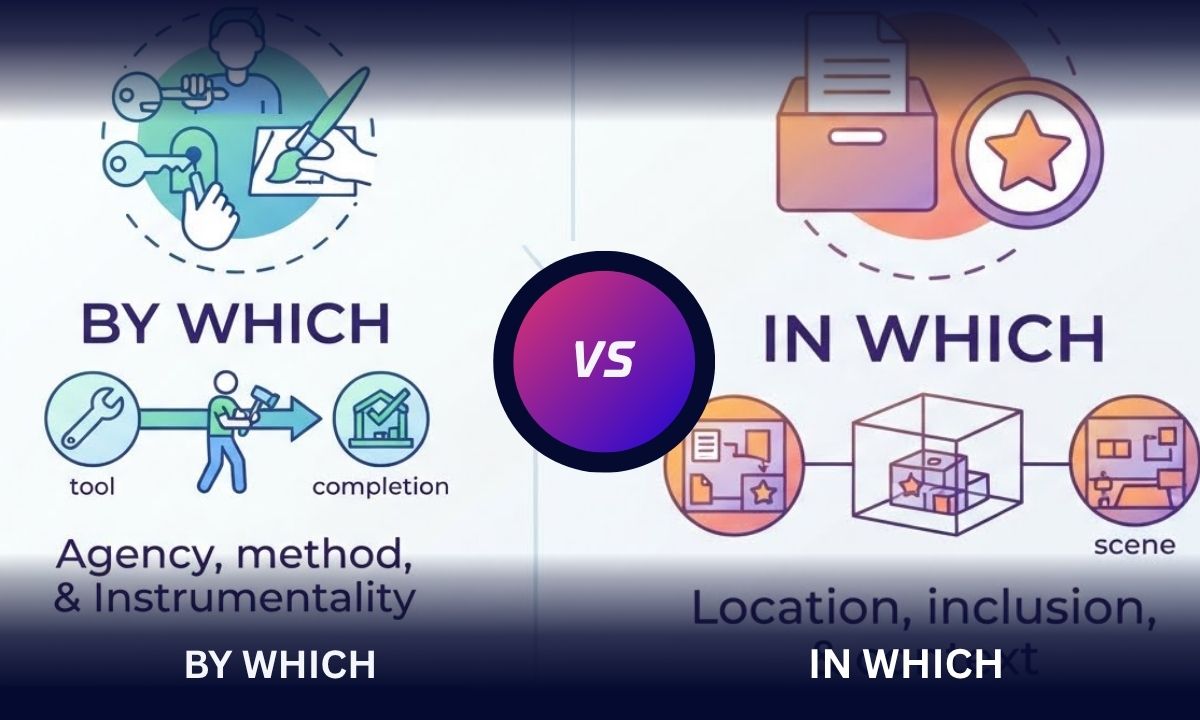
Many English learners get confused between by which and in which because both phrases are grammatically correct. The difficulty is knowing which one fits a particular sentence. Choosing the wrong preposition can change the meaning or make the sentence sound unnatural.
The good news is that the difference is easy to understand. By which usually explains the method, means, or way something happens, while in which refers to a place, situation, condition, or time. In this guide, you will learn the meaning of both phrases, their grammar rules, examples, common mistakes, and simple tips to remember the difference.
By Which or In Which: What’s the Difference?
The main difference between by which and in which depends on the relationship between the noun and the action that follows. Although both are relative phrases, they answer different questions and are not interchangeable.
By which explains how, through what means, or using what method something happens. It often shows the process or tool that makes an action possible.
In which explains where, during what situation, or under what condition something happens. It connects an action to a place, event, period, or circumstance.
Consider these examples:
- This is the process by which water is purified.
- This is the room in which the meeting was held.
In the first sentence, the phrase explains the method. In the second sentence, it identifies the location. Understanding this simple difference makes choosing the correct phrase much easier.
When Do You Use “By Which”?
Use by which when you want to explain the method, means, procedure, or way something happens. It often answers the question how.
This phrase is common in academic writing, scientific reports, legal documents, and formal English because it clearly describes the process behind an action.
Examples:
- The agreement explains the rules by which the company operates.
- This is the method by which the data was collected.
- The machine uses a system by which materials are sorted automatically.
- They described the process by which plants produce energy.
In each example, by which introduces the method or means used to achieve a result.
When Should You Use “In Which”?
Use in which when referring to a place, situation, event, condition, or period of time. It often answers the questions where or under what circumstances.
This phrase frequently appears in formal writing because it connects ideas smoothly without repeating information.
Examples:
- This is the city in which I was born.
- We discussed the situation in which the accident happened.
- She described the environment in which the children learn.
- That was the moment in which everything changed.
Here, in which introduces the location, condition, or situation connected to the main clause.
How Do Prepositions Change Meaning?
Prepositions play an important role in English because they show the relationship between words. A small change in the preposition can completely change the meaning of a sentence.
Compare these examples:
- The method by which the problem was solved.
- The classroom in which the lesson took place.
The first sentence focuses on the method. The second focuses on the place. Even though the grammar is similar, the meaning changes because of the preposition.
Choosing the correct preposition helps readers understand your sentence more clearly.
Examples Showing Both Phrases

Looking at both phrases side by side makes the difference easier to remember.
By which
- The process by which food is prepared is very simple.
- This is the system by which customers place orders.
- They explained the method by which the results were calculated.
In which
- This is the office in which she works.
- We visited the village in which my grandparents lived.
- The meeting took place in a room in which everyone felt comfortable.
Notice that by which explains how, while in which explains where or under what conditions.
Correct Usage Examples
The following sentences use each phrase correctly according to its meaning.
- The law describes the procedure by which applications are reviewed.
- Scientists studied the process by which cells divide.
- This is the building in which the museum is located.
- The report explains the circumstances in which the event occurred.
- We learned about the method by which clean water is produced.
- She remembered the year in which she graduated.
Each sentence uses the correct preposition based on the intended meaning.
Incorrect Usage Examples
Many learners choose the wrong preposition because they focus only on the grammar instead of the meaning.
Incorrect
- This is the room by which we had lunch.
Correct
- This is the room in which we had lunch.
Incorrect
- The process in which electricity is generated.
Correct
- The process by which electricity is generated.
Incorrect
- The city by which I grew up.
Correct
- The city in which I grew up.
Always think about whether you are describing a method or a place or situation before choosing the preposition.
Context Variations
The meaning of these phrases changes depending on the context.
Education
- The method by which students are assessed.
- The classroom in which students study.
Business
- The process by which products are delivered.
- The office in which employees work.
Science
- The mechanism by which viruses spread.
- The environment in which bacteria grow.
Law
- The procedure by which evidence is examined.
- The case in which the judge made the decision.
Understanding the context makes selecting the correct phrase much easier.
Common Mistakes with Relative Clauses

Many writers confuse by which and in which because both are relative clauses introduced by which.
Some common mistakes include:
- Using by which when talking about a place.
- Using in which when explaining a method.
- Translating directly from another language.
- Ignoring the relationship between the noun and the action.
The easiest solution is to identify what the sentence is describing before choosing the preposition.
Memory Tricks for Choosing Correctly
You can remember the difference with two simple questions.
Ask yourself:
Does the sentence explain how something happens?
If the answer is yes, use by which.
Does the sentence explain where, when, or under what conditions something happens?
If the answer is yes, use in which.
Another easy trick is this:
- By often means through, using, or by means of.
- In often refers to a place, time, or situation.
These simple reminders will help you make the correct choice more quickly.
Frequently Asked Questions
Is “by which” grammatically correct?
Yes. By which is grammatically correct when referring to the method, means, or process through which something happens.
Is it correct to use “in which”?
Yes. In which is correct when referring to a place, situation, condition, or period of time.
What does “by which” mean?
By which means through which, using which, or by means of which. It explains how something is done or achieved.
What type of preposition is by?
By is a common English preposition. It can indicate method, means, agency, proximity, or time depending on the sentence.
Can “by which” and “in which” be used interchangeably?
No. Although both are grammatically correct, they have different meanings. By which describes a method, while in which describes a place, situation, or condition.
Conclusion
The difference between by which and in which is based on meaning rather than grammar alone. Use by which when describing the method or means by which something happens. Use in which when referring to a place, situation, event, or condition.
Once you focus on what the sentence is describing, choosing the correct phrase becomes much easier. Practicing with real examples will help you use both expressions naturally in speaking and writing.

Eliana is an English language writer with 10 years of experience. She creates simple grammar guides, vocabulary tips, and writing resources for GrammerMint readers.