
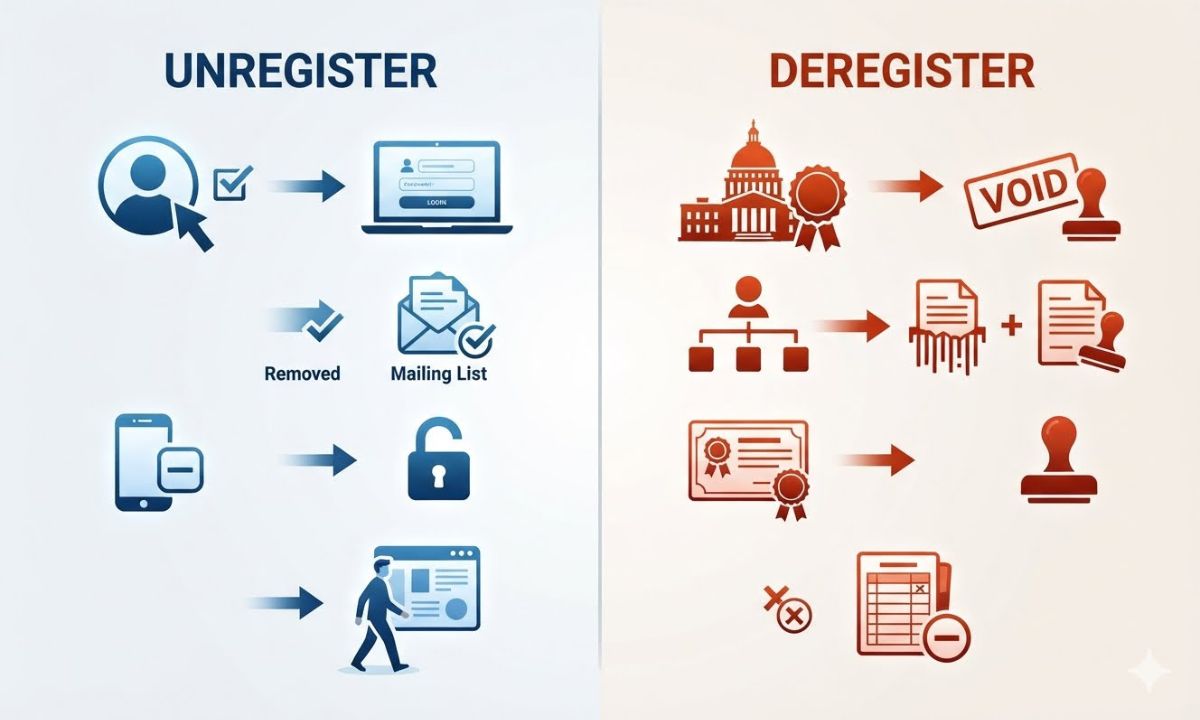
Many people think unregister and deregister mean exactly the same thing. They are very similar, but they are not always used in the same situations. The correct choice depends on the context, especially in technology, law, business, and official documents.
In this guide, you will learn the meaning of both words, their differences, where each one is used, and how to remember the correct choice. By the end, you will know when to use unregister and when deregister with confidence.
What Does Unregister Mean?
Unregister means to remove something from a register, list, account, or system. It usually refers to canceling a registration or disconnecting a device, service, or account from a platform.
The word is commonly used in computing, software, and everyday situations where an item is removed from an active list.
Examples
- Please unregister your old phone before adding a new one.
- I forgot to unregister my email account from the app.
- The administrator will unregister the device after the project ends.
- You should unregister from the event if you cannot attend.
The word focuses on removing something from a system or registration without suggesting any legal process.
What Does Deregister Mean?
Deregister means to officially remove a person, company, vehicle, product, or organization from an official register. It often refers to a legal, government, or administrative action.
This word is common in business, finance, transportation, healthcare, and government documents.
Examples
- The company decided to deregister after closing its business.
- You must deregister the vehicle before selling it abroad.
- The charity was deregistered by the government authority.
- Investors voted to deregister the company from the stock exchange.
Unlike unregister, deregister usually implies a formal or official process.
Unregister vs Deregister

Although both words mean removing something from a register, they are used in different situations.
| Unregister | Deregister |
| Used in everyday and technical situations | Used in official and legal situations |
| Removes from a system or account | Removes from an official register |
| Common in software and technology | Common in law, business, finance, and government |
| Usually informal or technical | Usually formal and administrative |
Quick Comparison
- Use unregister for devices, apps, software, websites, and user accounts.
- Use deregister for companies, vehicles, charities, trademarks, and legal registrations.
- Both can sometimes describe removing something from a list, but the level of formality is different.
Unregister vs Deregister Usage Context
Choosing the right word becomes easy when you understand the situation.
Use unregister when talking about technology or personal accounts.
Examples
- Unregister your smartwatch before resetting it.
- I need to unregister my account from this website.
- The software automatically unregisters inactive devices.
Use deregister when talking about official records or legal matters.
Examples
- The company was deregistered after liquidation.
- You must deregister your business if it permanently closes.
- The owner deregistered the vehicle before exporting it.
A simple rule is that if a government office or legal authority is involved, deregister is usually the better choice.
Why Does Your Brain Short Circuit on These Two Words?
Many English learners become confused because both words start with prefixes that indicate removal.
The prefix un means to reverse or remove an action.
The prefix de also means to remove, reduce, or reverse.
Since both prefixes have similar meanings, people often think the words are interchangeable. In reality, English has developed different usage patterns over time.
Another reason for confusion is that software companies sometimes use unregister, while government agencies almost always use deregister. Seeing both words in different places makes it difficult to know which one is correct.
The easiest way to remember the difference is this.
- Unregister usually removes something from a system.
- Deregister usually removes something from an official record.
This simple distinction will help you choose the correct word in most situations.
Core Concepts and Historical Evolution
Both unregister and deregister describe removing something from a register. However, they developed in different fields and now carry different meanings in modern English.
In the past, the word register mainly referred to an official written record kept by governments, churches, or businesses. As technology grew, the idea of a register expanded to include computers, databases, websites, and online accounts.
Today, unregister is more common in technology and everyday communication. Deregister remains the preferred choice in legal, administrative, and regulatory writing.
Etymology and the Germanic Latin Divide
The word register comes from the Latin word registrum, meaning a written record or list.
The prefix un comes from Old English and is used to reverse an action.
Examples include:
- Unlock
- Untie
- Unplug
- Uninstall
The prefix de comes from Latin and often means to remove, reduce, or reverse.
Examples include:
- Deactivate
- Decode
- Declassify
- Deregulate
Because these prefixes come from different language traditions, English allows both unregister and deregister. Over time, each word found its own preferred usage.
Grammatical Mechanics and Reversative Verbs
Both words are reversative verbs. This means they describe reversing a previous action.
For example:
- Register a device → Unregister the device.
- Register a company → Deregister the company.
Both verbs can appear in different tenses.
Unregister
- Register
- Unregister
- Unregistered
- Unregistering
Deregister
- Deregister
- Deregistered
- Deregistering
Both are grammatically correct. The difference is not grammar but context.
When Should You Use Unregister vs. Deregister?
Choosing between these words becomes simple when you think about what is being removed.
Use unregister when removing something from a digital system, application, website, or user account.
Examples
- Unregister your phone before giving it away.
- Please unregister your email from the newsletter.
- The software failed to unregister the old device.
Use deregister when removing something from an official or legal record.
Examples
- The business owner decided to deregister the company.
- You must deregister the vehicle before exporting it.
- The organization was deregistered after it stopped operating.
If the action involves a government office, legal authority, or official registry, deregister is usually the correct word.
Technical and Computing Contexts
Technology is where unregister appears most often.
Developers, IT professionals, and software companies use it when removing devices, accounts, services, or software components from a system.
Common examples include:
- Unregister a mobile device
- Unregister an application
- Unregister a user account
- Unregister a software component
- Unregister a notification service
Example sentences:
- The app automatically unregisters inactive devices.
- You should unregister your old computer before installing the software elsewhere.
- The administrator unregistered the server from the network.
Although some technical documents use deregister, unregister is generally more common in software documentation.
Legal and Regulatory Contexts
In legal and administrative writing, deregister is the standard choice.
Governments and regulatory agencies use it when something is officially removed from an approved register.
Common examples include:
- Deregister a company
- Deregister a charity
- Deregister a trademark
- Deregister a vehicle
- Deregister a financial institution
Example sentences:
- The company was deregistered after liquidation.
- You must deregister the vehicle before leaving the country.
- The regulator deregistered the organization for failing to meet legal requirements.
These actions usually involve official paperwork, legal approval, or government records.
The Nuance Trap
Many dictionaries list unregister and deregister as similar words, which leads people to believe they can always replace one another.
In reality, native English speakers often choose the word that sounds natural for the situation.
Compare these examples:
✔ Please unregister your laptop from the company network.
✔ The company was deregistered by the government.
These sentences sound natural because each word matches its usual context.
Now compare these:
✘ Please deregister your laptop from the app.
✘ The government unregistered the company.
Although people may understand the meaning, these choices sound unusual because they do not match standard usage.
The safest approach is simple.
- Use unregister for technology and personal systems.
- Use deregister for legal and official records.
How Writers Actually Use Unregister vs. Deregister in Print

Professional writers choose these words based on the audience and the subject. Technical writers usually prefer unregister because it matches the language used in software and digital systems. Legal writers, government agencies, and business professionals usually prefer deregister because it sounds more formal and official.
Using the right word makes your writing clearer and more natural. It also helps readers understand whether you are talking about a computer system or an official record.
Examples
Technical writing
- Unregister your device before installing the application on another computer.
- The software automatically unregisters inactive users.
Professional writing
- The company applied to deregister after completing the merger.
- The charity was deregistered by the regulatory authority.
Historical Usage in Technical Documentation
Older computer manuals often used unregister when describing the removal of hardware, software, or user accounts from a system. As technology expanded, this usage became the standard in many software guides.
Examples include:
- Unregister a software license.
- Unregister a printer.
- Unregister a user account.
- Unregister a device from the network.
Some technical documents also use deregister, especially in networking and telecommunications. However, unregister is still the word most users encounter in everyday software documentation.
Modern Style in Professional Writing
Modern style guides encourage writers to choose words that fit the situation rather than simply picking synonyms.
In professional writing:
- Use unregister for apps, devices, software, and online services.
- Use deregister for companies, vehicles, trademarks, charities, and official records.
Being consistent throughout a document is more important than switching between the two words.
Synonyms and Variations of Unregister vs. Deregister
Depending on the sentence, you may also use similar words.
Synonyms for Unregister
- Remove
- Disconnect
- Delete
- Deactivate
- Unlink
- Cancel registration
Synonyms for Deregister
- Remove from the register
- Cancel registration
- Officially remove
- Revoke registration
- Terminate registration
Remember that these words are not always perfect replacements. Choose the one that best matches the context.
Semantic Neighbors and Illocutionary Force
Both words express the idea of removal, but they create different impressions.
Unregister sounds practical and technical. It usually refers to an action performed by a user or a computer system.
Deregister sounds formal and administrative. It often suggests an official decision made by an authority or government body.
For example:
- The user unregistered the device.
- The government deregistered the company.
The action is similar, but the tone is different.
Regional Variations
Both British and American English recognize unregister and deregister.
However, there are small differences in usage.
In many English speaking countries:
- Unregister is more common in software, websites, and digital platforms.
- Deregister is more common in government documents, legal writing, and business regulations.
No matter where you are writing, following the normal usage for the subject will make your content sound natural.
Common Mistakes When Choosing Unregister vs. Deregister
Many learners make the same mistakes because the words have similar meanings.
Common mistakes include:
- Using deregister for apps or online accounts.
- Using unregister for companies or official legal records.
- Switching between both words in the same article without a reason.
- Assuming both words always mean exactly the same thing.
Avoid these mistakes by remembering the context instead of focusing only on the definition.
Practical Tips and How I Learned This the Hard Way
A simple way to remember the difference is to think about who controls the action.
If you remove something from an app, website, or device, unregister is usually the right choice.
If an authority removes something from an official record, deregister is usually correct.
This small habit makes it much easier to choose the right word while writing or speaking.
When Consistency Matters More Than Correctness
Sometimes both words could technically be understood, especially in technical discussions.
Even so, changing between unregister and deregister throughout the same document can confuse readers.
Choose one word that matches your topic and use it consistently.
For example:
- A software guide should consistently use unregister.
- A legal guide should consistently use deregister.
Consistency improves readability and gives your writing a more professional appearance.
Memory Aids That Actually Work
These easy memory tricks can help you remember the difference.
- Unregister starts with Un, which can remind you of User. Users usually unregister devices and accounts.
- Deregister starts with De, which can remind you of Department or Government Department. Official authorities often deregister companies and vehicles.
- Think Technology equals Unregister.
- Think Legal records equals Deregister.
Frequently Asked Questions
Is it deregister or unregister?
Both words are correct, but they are used in different situations. Use unregister for software, devices, websites, and online accounts. Use deregister for companies, vehicles, charities, and other official registrations.
Do you say deregister or unregister?
The correct choice depends on the context. If you are talking about removing something from a digital system, say unregister. If you are talking about removing something from an official government or legal register, say deregister.
Is unregister a word?
Yes. Unregister is a real English word. It is widely used in computing, software documentation, websites, and digital services. It means to remove something from a system or registration.
What does “deregister” mean?
Deregister means to officially remove a person, company, vehicle, product, or organization from an official register. It is commonly used in legal, business, financial, and government contexts.
Can unregister and deregister be used interchangeably?
Sometimes they have a similar meaning, but they are not always interchangeable. Unregister is best for technical and everyday use, while deregister is the preferred word for legal and official matters. Using the correct word makes your writing more accurate and professional.
Conclusion
Although unregister and deregister both describe removing something from a register, they are not used in exactly the same way. Unregister is most common in technology, software, websites, and user accounts. Deregister is mainly used for official records involving businesses, vehicles, charities, trademarks, and government authorities.
The easiest way to remember the difference is to think about the context. If the action involves a digital system or personal account, choose unregister. If it involves a legal or official register, choose deregister. Following this simple rule will help you use both words correctly in everyday writing and professional communication.

Eliana is an English language writer with 10 years of experience. She creates simple grammar guides, vocabulary tips, and writing resources for GrammerMint readers.