
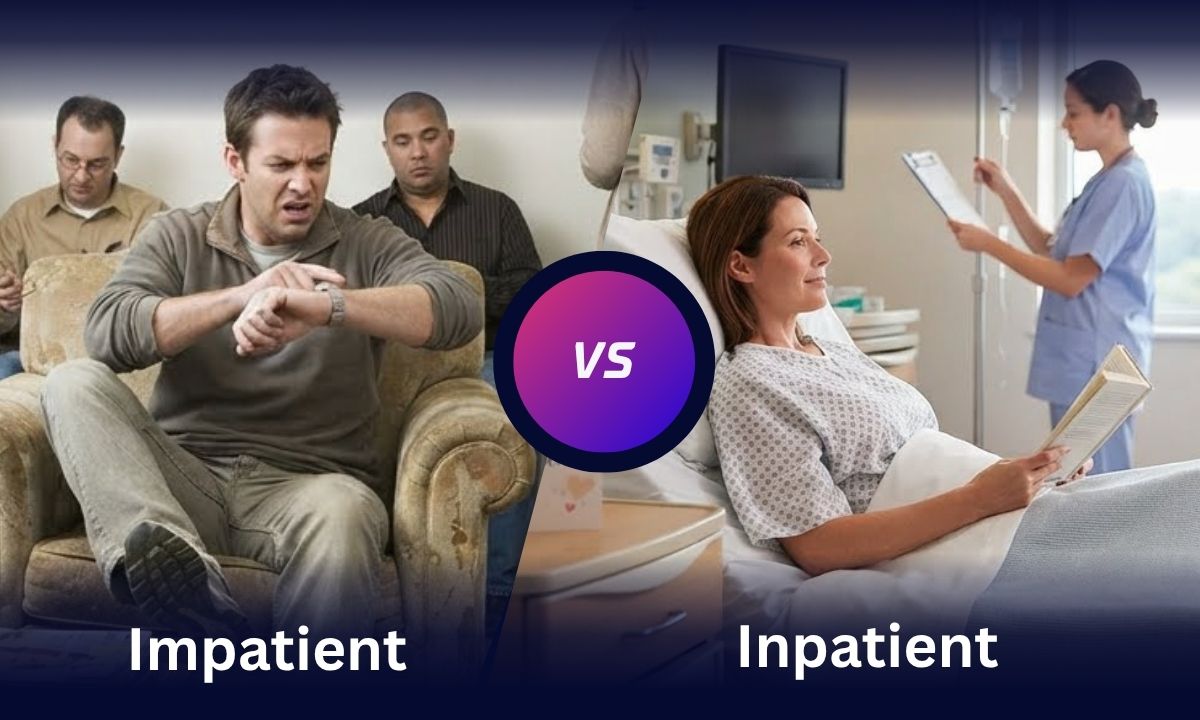
Many English learners confuse impatient and inpatient because the two words look almost identical. The only difference is one letter, but their meanings are completely different. Using the wrong word can change the meaning of your sentence and cause confusion.
The good news is that the difference is easy to understand. Impatient describes a person’s feelings or behavior, while inpatient is a medical term used for someone who stays in a hospital for treatment. This guide explains both words, their meanings, examples, and the correct way to use them.
Quick Overview
Here is a simple comparison of the two words.
| Impatient | Inpatient |
| Describes a person’s feelings | Refers to a hospital patient |
| Means unable to wait calmly | Means admitted to a hospital for treatment |
| Common in everyday English | Common in medical settings |
| Adjective | Noun or adjective |
Although they are spelled similarly, they are never interchangeable.
What Does “Impatient” Mean?
Impatient is an adjective that describes someone who becomes annoyed, restless, or frustrated because they have to wait or because something is taking too long.
People often use this word in everyday conversations, schools, workplaces, and family situations. It expresses a feeling rather than describing a medical condition.
Definition and Pronunciation
Definition: Feeling annoyed because you cannot wait calmly.
Pronunciation: im PAY shunt
Examples:
- The children became impatient while waiting for lunch.
- She was impatient for the meeting to begin.
- He grew impatient after standing in line for an hour.
- Don’t be impatient. Your turn will come soon.
When to Use “Impatient” in Sentences
Use impatient whenever you are talking about emotions, attitudes, or behavior related to waiting.
Examples:
- I became impatient during the long flight.
- The customer sounded impatient on the phone.
- She is impatient to hear the exam results.
- We were impatient because the train was late.
- He looked impatient while waiting outside.
In every example, the word describes how someone feels.
What Does “Inpatient” Mean?
Inpatient is a medical term that refers to a patient who has been admitted to a hospital and stays there for treatment or observation. Unlike an outpatient, an inpatient remains in the hospital overnight or for several days.
Doctors, nurses, hospitals, and insurance companies commonly use this word.
Definition and Pronunciation
Definition: A patient who stays in a hospital while receiving treatment.
Pronunciation: IN pay shunt
Examples:
- The doctor admitted her as an inpatient.
- He remained an inpatient for three days.
- The hospital has a separate inpatient department.
- She received inpatient care after surgery.
When to Use “Inpatient” in Medical Context
Use inpatient only when discussing hospital care or medical treatment.
Common situations include:
- Hospital admission
- Surgery recovery
- Long term treatment
- Medical observation
- Specialized hospital care
Examples:
- The patient became an inpatient after the operation.
- Inpatient services include nursing care and monitoring.
- The doctor recommended inpatient treatment.
- She spent a week in the inpatient ward.
Inpatient vs. Outpatient
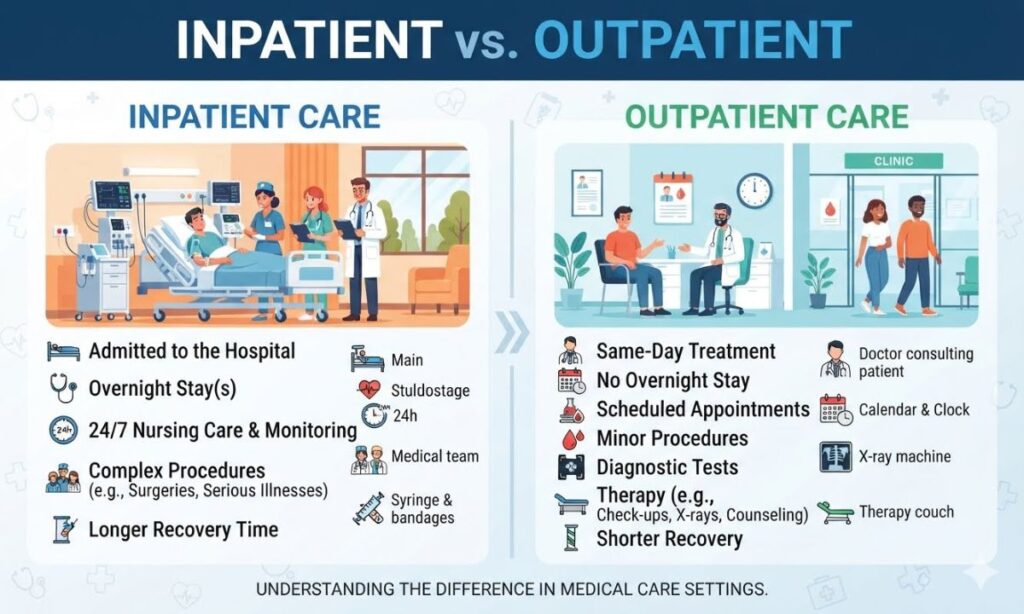
People often confuse inpatient with outpatient, but they describe different types of medical care.
| Inpatient | Outpatient |
| Stays in the hospital | Goes home the same day |
| Receives overnight care | Does not stay overnight |
| Used for serious conditions or surgery | Used for routine checkups and minor procedures |
| Requires hospital admission | No hospital admission required |
Examples:
- He became an inpatient after heart surgery.
- I visited the clinic as an outpatient for a routine examination.
Understanding this difference is useful when reading medical documents or speaking with healthcare professionals.
Examples of Impatient vs. Inpatient in Sentences
Looking at both words together makes the difference much clearer.
Impatient
- The children became impatient during the long trip.
- She was impatient to receive the good news.
- We grew impatient because the service was slow.
- He sounded impatient while waiting on the phone.
- The audience became impatient after the delay.
Inpatient
- The doctor admitted him as an inpatient.
- She received excellent inpatient care.
- The hospital expanded its inpatient facilities.
- My grandfather remained an inpatient for five days.
- The nurse checked every inpatient in the ward.
Remember that impatient describes feelings, while inpatient refers to hospital patients.
Frequently Asked Questions
What is the difference between impatient and inpatient?
Impatient means feeling frustrated or unable to wait calmly. Inpatient refers to a person who stays in a hospital for treatment.
Why is it impatient and not inpatient?
Use impatient when talking about emotions or behavior. Use inpatient only in medical situations involving hospital care.
Which is correct, impatient or impatience?
Both are correct but have different grammar.
Impatient is an adjective.
Impatience is a noun.
Examples:
- She became impatient.
- His impatience was obvious.
Which is correct, in patient or inpatient?
Inpatient as one word is the correct medical term. Writing in patient as two words is generally incorrect unless the words happen to appear separately for another reason in a sentence.
Can someone be both impatient and an inpatient?
Yes. A person staying in a hospital can also feel impatient while waiting for treatment or recovery.
Conclusion
Although impatient and inpatient differ by only one letter, their meanings are completely different. Impatient describes someone who cannot wait calmly or becomes frustrated easily. Inpatient refers to a patient who stays in a hospital for medical treatment.
Remember this simple rule. If the sentence is about emotions or waiting, use impatient. If it is about hospital care, use inpatient. Keeping this difference in mind will help you write and speak English more accurately.

Eliana is an English language writer with 10 years of experience. She creates simple grammar guides, vocabulary tips, and writing resources for GrammerMint readers.