
“What time is 18 hours from now?” is a useful question when planning work shifts, travel, appointments, sleep schedules, deadlines, or reminders. Because 18 hours is longer than half a day, the calculation often crosses midnight and moves into the next calendar day.
The exact answer depends on the current time and time zone. For example, if it is 7:41 AM, adding 18 hours gives 1:41 AM the following day. The minutes stay the same when you add a whole number of hours.
Understanding What Time Is 18 Hours From Now
Eighteen hours from now means adding exactly 18 hours to the current date and time.
There are:
- 18 hours
- 1,080 minutes
- 64,800 seconds
- 0.75 of a 24-hour day
Because 18 hours is three-quarters of a day, the resulting time will often fall on the next calendar day.
For example:
7:00 AM + 18 hours = 1:00 AM tomorrow
The important point is that the date can change even though the calculation only adds hours.
Why People Search “18 Hours From Now Is What Time?”
People commonly need future-time calculations when they have an event or task scheduled a certain number of hours from the present.
Common examples include:
- Planning an overnight work shift
- Calculating a future appointment
- Setting a reminder
- Planning travel
- Tracking a sleep period
- Coordinating with someone in another location
- Managing project deadlines
- Planning online events
Instead of manually counting through the clock, an hours-from-now calculation gives a direct answer.
How to Calculate 18 Hours From Now Manually
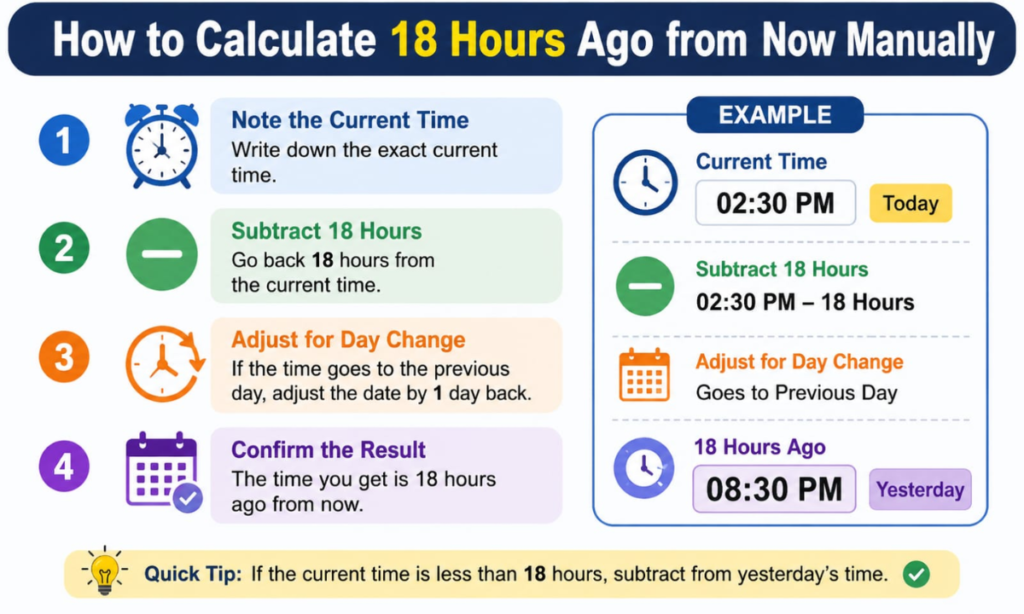
The simplest approach is to add 18 hours to the current time.
Step One: Note the Current Time
Start by checking your current local time.
For example:
Current time: 7:30 AM
Write the time down before performing the calculation.
Step Two: Add 18 Hours
Add 18 to the hour while keeping the minutes unchanged.
7:30 AM + 18 hours
First add 12 hours:
7:30 AM + 12 hours = 7:30 PM
Then add the remaining 6 hours:
7:30 PM + 6 hours = 1:30 AM
Therefore:
18 hours from 7:30 AM = 1:30 AM the next day.
Step Three: Check the Date
Because the calculation passed midnight, the result belongs to the following calendar day.
This final step is important because giving only the future clock time can be misleading.
What Time Will It Be in 18 Hours If Midnight Is Crossed?
Most 18-hour calculations cross midnight because the interval covers 18 of the 24 hours in a day.
For example:
Current time: 8:00 PM
Add 4 hours:
8:00 PM → 12:00 AM
You still have 14 hours remaining.
Add another 14 hours:
12:00 AM → 2:00 PM
Therefore:
8:00 PM + 18 hours = 2:00 PM tomorrow.
When midnight is crossed, always move the calendar date forward by one day.
What Time Is 18 Hours From Now Using the 24-Hour Clock?
The 24-hour clock makes time calculations easier because AM and PM do not need to be switched manually.
For example:
20:30 + 18 hours
Add the hours:
20 + 18 = 38
Since a day has 24 hours:
38 − 24 = 14
The result is:
14:30 the next day
In the 12-hour format, that is:
2:30 PM the next day.
The minutes remain unchanged when adding exactly 18 hours.
The Role of Modular Arithmetic in Time Calculation
Time calculations can also be understood using a simple mathematical idea called modular arithmetic.
A clock repeats every 24 hours. Once you reach 24:00, the clock returns to 00:00.
The basic formula is:
Future hour = (Current hour + 18) mod 24
For example, if the current hour is 20:
(20 + 18) mod 24 = 14
So 20:00 plus 18 hours becomes 14:00 on the next day.
This method is particularly useful for computer programs, digital clocks, scheduling systems, and time calculators.
Read This: What Date Is 9 Weeks From Today? Calculate the Exact Future Date
Common Examples of 18 Hours From Now
Here are several examples showing how the calculation works.
| Current Time | 18 Hours Later | Day |
| 1:00 AM | 7:00 PM | Same day |
| 5:00 AM | 11:00 PM | Same day |
| 6:00 AM | 12:00 AM | Next day |
| 8:00 AM | 2:00 AM | Next day |
| 10:00 AM | 4:00 AM | Next day |
| 12:00 PM | 6:00 AM | Next day |
| 2:00 PM | 8:00 AM | Next day |
| 6:00 PM | 12:00 PM | Next day |
| 9:00 PM | 3:00 PM | Next day |
| 11:00 PM | 5:00 PM | Next day |
Notice that the minutes remain unchanged in each example because exactly 18 whole hours are being added.
Using an Online Hours From Now Calculator
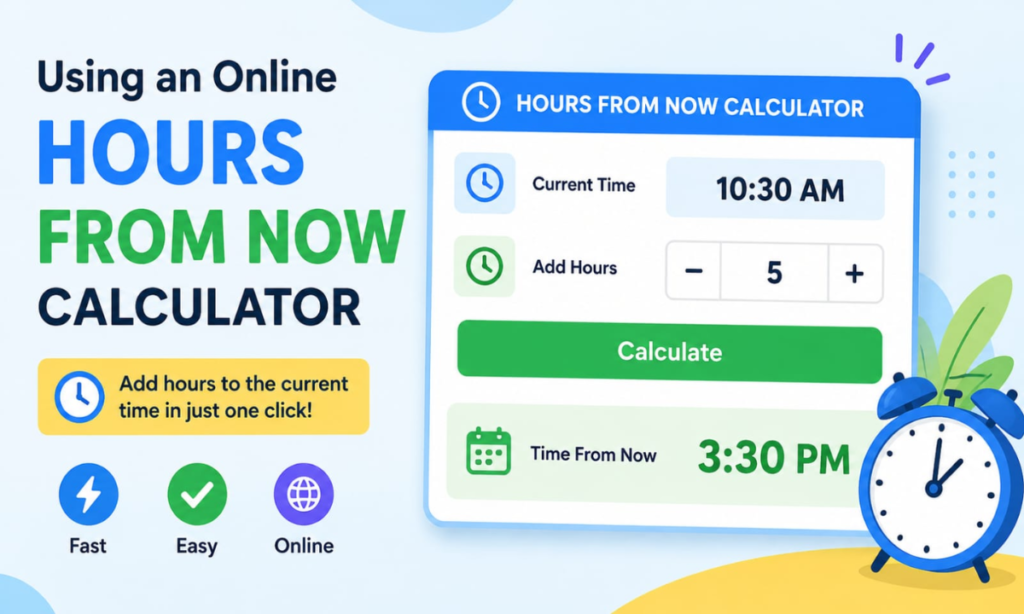
An hours-from-now calculator can perform the calculation automatically. These tools typically use the current clock and add the requested number of hours, then display the resulting time and date.
Many calculators can also account for:
- The next calendar day
- AM and PM changes
- 12-hour and 24-hour formats
- Time zones
- Date changes
- Exact minutes and seconds
This is useful when the current time includes seconds and you want the future timestamp to be precise.
Why Date Rollover Matters
A future time calculation is incomplete if you ignore the date.
Suppose it is:
10:00 PM on Monday
Adding 18 hours gives:
4:00 PM on Tuesday
The clock time is 4:00 PM, but the day has changed.
This matters for appointments, deadlines, flights, reservations, work schedules, and reminders. A correct future-time answer should ideally include both the time and date.
What Time Is 18 Hours From Now in GMT+5?
GMT+5 is a time-zone offset that is five hours ahead of Coordinated Universal Time.
If your current clock is set to GMT+5, calculate the future time using that local clock.
For example:
Current time: 8:00 PM GMT+5
Add 18 hours:
8:00 PM + 18 hours = 2:00 PM the next day
The time-zone label does not change the basic 18-hour duration. It simply identifies which local clock is being used.
Time Zones and Future Time Calculations
Time zones become important when people in different locations coordinate an event.
For example, someone in one country may be at 9:00 AM while another person is already at 2:00 PM. If both people ask what time it will be 18 hours from now, they need to calculate from their respective local times.
When working internationally, always check:
- Current local time
- Current date
- Time-zone offset
- Target date
- Whether daylight-saving rules apply
This prevents confusion when scheduling across countries.
Real-Life Uses of 18-Hour Time Projection
Travel Planning
Travelers can use an 18-hour calculation to estimate future check-in times, arrival windows, or connecting activities.
Work Deadlines
Employees and freelancers may need to know exactly when a deadline will occur after a specified number of hours.
Sleep Schedules
People tracking long sleep or wake periods can use time arithmetic to understand when a future period ends.
Reminder Systems
Adding 18 hours can help determine when a reminder, notification, or scheduled task should occur.
Event Coordination
Online events involving people in different locations often require careful time calculations to avoid scheduling mistakes.
Human Perception of Waiting for 18 Hours
Eighteen hours can feel very different depending on what you are doing.
An 18-hour period may seem long when waiting for an important event but pass quickly during a busy day. This is one reason people often prefer an exact countdown instead of estimating the duration mentally.
A countdown can break the period into smaller units:
18 hours → 1,080 minutes → 64,800 seconds
Seeing the remaining duration in smaller units can make a long wait easier to understand.
Future Timestamp Calculations
For technical applications, the same calculation can be represented as a future timestamp.
A computer can convert a date and time into a numerical representation, add the required duration, and then convert the result back into a readable date and time.
For an exact 18-hour interval:
18 hours × 60 = 1,080 minutes
And:
1,080 × 60 = 64,800 seconds
This is why digital systems can calculate future times very quickly.
Common Mistakes When Adding 18 Hours
Several simple mistakes can produce an incorrect answer.
Forgetting the Next Day
If the calculation passes midnight, remember to move the date forward.
Mixing AM and PM
Adding hours on a 12-hour clock can cause confusion if AM and PM are not tracked carefully.
Ignoring Time Zones
A future time should be based on the correct local time zone when different locations are involved.
Incorrect 24-Hour Conversion
Remember:
- 1:00 PM = 13:00
- 2:00 PM = 14:00
- 6:00 PM = 18:00
- 9:00 PM = 21:00
- 12:00 AM = 00:00
Skipping Midnight Logic
When the calculation goes beyond 24:00, subtract 24 from the hour and move to the next date.
Tools That Help Calculate Future Time
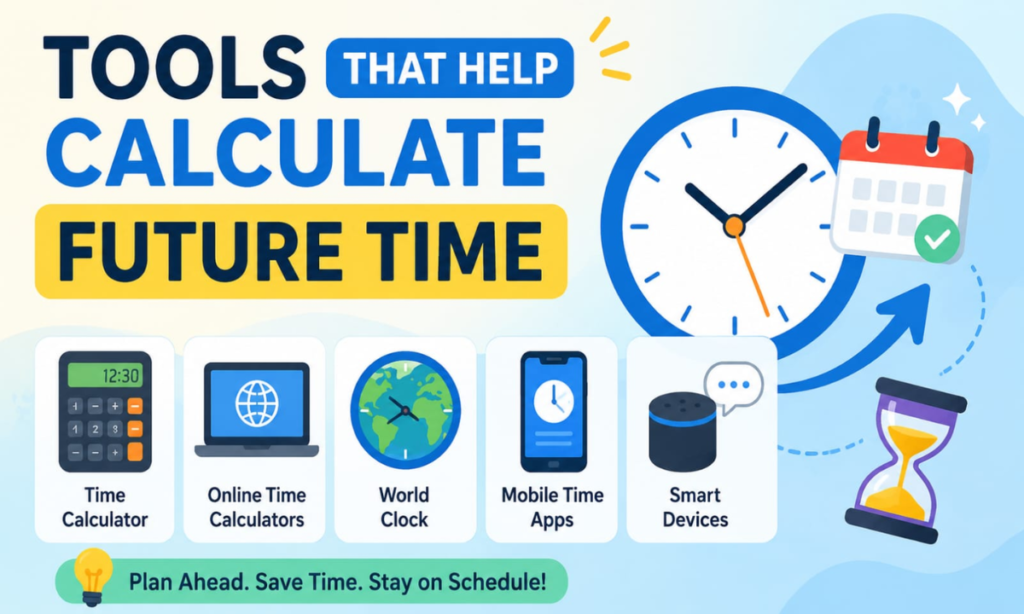
Different tools can make future-time calculations easier.
| Tool | Best For |
| Digital clock | Checking the current time |
| Hours-from-now calculator | Finding an exact future time |
| Countdown timer | Watching the remaining duration |
| Calendar | Planning future events |
| Alarm | Receiving a notification |
| 24-hour clock | Simplifying time arithmetic |
For simple calculations, mental math is usually sufficient. For precise scheduling, a digital calculator or calendar reminder can reduce errors.
Conclusion
Calculating what time is 18 hours from now is straightforward once you understand how the clock and date work together. Add 18 hours to the current time, keep the minutes unchanged, and move to the next date whenever the calculation crosses midnight.
For example, 8:00 AM plus 18 hours equals 2:00 AM the next day. Using the 24-hour clock or a digital time calculator can make these calculations even easier, especially when exact dates, seconds, or time zones are involved.
Frequently Asked Questions
What time is 18 hours from now?
The exact answer depends on your current local time. Add 18 hours to your current clock time and move to the next date if midnight is crossed.
How many minutes are in 18 hours?
There are 1,080 minutes in 18 hours.
How many seconds are in 18 hours?
There are 64,800 seconds in 18 hours.
Does 18 hours from now usually mean tomorrow?
Often, yes. Since 18 hours is less than 24 but longer than 12 hours, it frequently crosses midnight and reaches the following calendar day.
What is 18 hours from 2:00 PM?
Adding 18 hours to 2:00 PM gives 8:00 AM the next day.
What is 18 hours from 8:00 PM?
Adding 18 hours to 8:00 PM gives 2:00 PM the next day.
How do I calculate 18 hours using the 24-hour clock?
Add 18 to the current hour. If the result reaches 24 or more, subtract 24 and move the date forward by one day.
Does the date change when adding 18 hours?
It depends on the starting time. If the calculation passes midnight, the result occurs on the next calendar day.
Does the time zone affect the answer?
The 18-hour duration itself does not change, but the displayed local time and date depend on the time zone being used.
Can I calculate 18 hours from now without a calculator?
Yes. Add 18 hours manually, track whether you pass midnight, and adjust the date accordingly.

Eliana is an English language writer with 10 years of experience. She creates simple grammar guides, vocabulary tips, and writing resources for GrammerMint readers.