
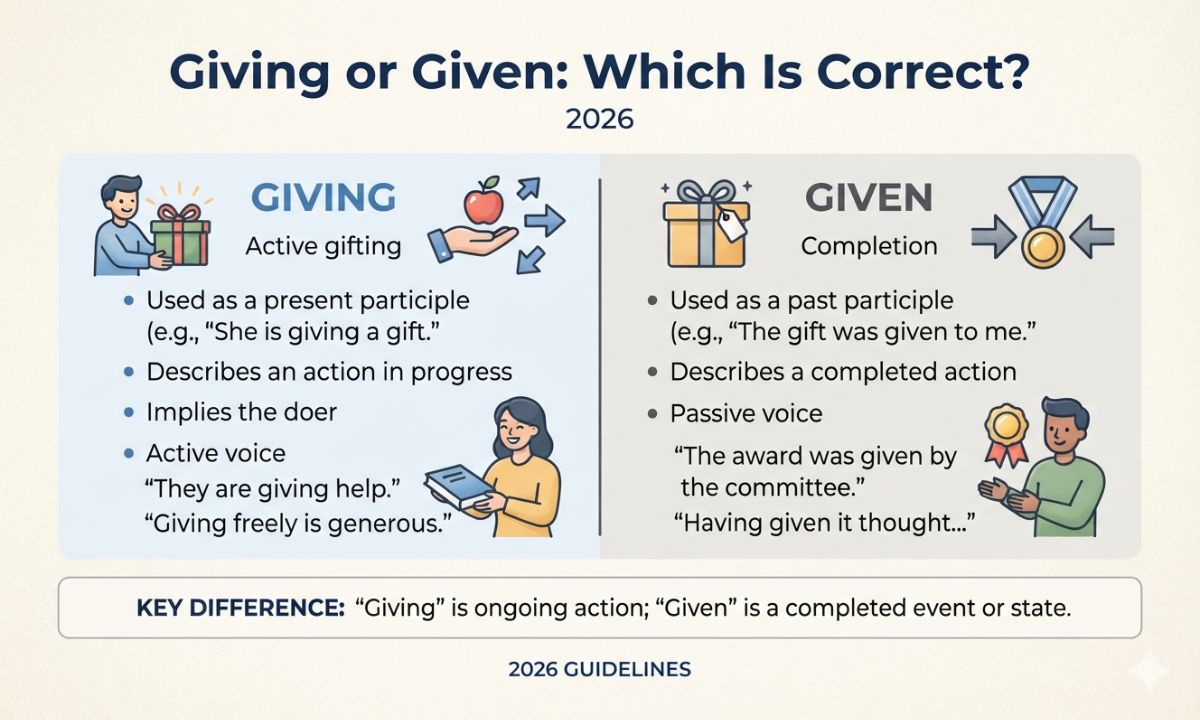
Many English learners get confused between giving and given because both words come from the verb give. They look similar, but they have different meanings and grammar rules. Using the wrong one can make your sentence incorrect.
In this guide, you will learn the difference between giving and given in simple English. You will also see grammar rules, easy examples, common mistakes, and tips to help you use both words correctly.
Understanding “Giving”
Giving is the present participle and gerund form of the verb give. It describes an action that is happening now, continuing over a period of time, or functioning as a noun.
Examples
- She is giving a presentation today.
- They are giving free books to students.
- Giving is an important part of kindness.
- He kept giving useful advice.
Key Points
- Shows an ongoing action.
- Used in continuous tenses.
- Can also function as a noun.
- Comes from the base verb give.
Present Continuous Usage of “Giving”
The present continuous tense uses am, is, or are followed by giving. This tense describes actions happening now or around the present time.
Structure
Subject + am/is/are + giving + object
Examples
- I am giving my opinion.
- She is giving a speech.
- They are giving discounts today.
- We are giving our full support.
Past and Perfect Continuous Forms
The word giving is also used in continuous tenses that describe actions happening over time in the past or continuing until the present.
Past Continuous
- He was giving instructions when I arrived.
- They were giving interviews yesterday.
Present Perfect Continuous
- She has been giving piano lessons for five years.
- I have been giving my best effort.
Past Perfect Continuous
- They had been giving support before the project ended.
Common Mistakes with “Giving”
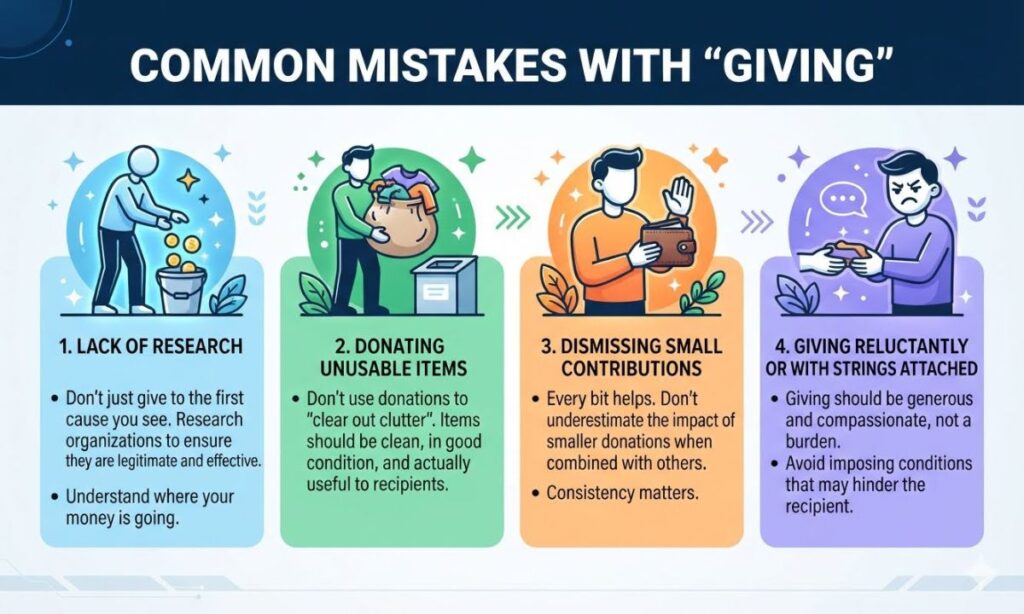
Many learners use giving where given should be used. This mistake often happens in perfect tenses and passive voice.
Incorrect
- I have giving you the file.
- The award was giving yesterday.
- She has giving her answer.
Correct
- I have given you the file.
- The award was given yesterday.
- She has given her answer.
Tips
- Use giving for ongoing actions.
- Never use giving after have, has, or had without been.
- Use given in passive voice.
Understanding “Given”
Given is the past participle of the verb give. It is used in perfect tenses, passive voice, and can also work as an adjective or a preposition depending on the sentence.
Examples
- She has given her answer.
- The prize was given to the winner.
- Given his experience, he was hired quickly.
- The information given was accurate.
Key Points
- It is the past participle of give.
- Used with have, has, and had.
- Common in passive voice.
- Can also be an adjective or a preposition.
“Given” in Perfect Tenses
Perfect tenses always use the past participle given.
Structure
Subject + have/has/had + given + object
Examples
- I have given my opinion.
- She has given me a gift.
- They had given us enough time.
- We have given our best effort.
Remember
Never write I have giving or She has giving. The correct form is always given after have, has, or had.
“Given” as an Adjective
Sometimes given describes a noun instead of acting as a verb. In this case, it means specified, provided, or particular.
Examples
- The given instructions were easy to follow.
- Work within the given time.
- Use the given password.
- Every given example was helpful.
“Given” as a Preposition
Given can also be used as a preposition. It means considering or taking into account.
Examples
- Given the weather, we stayed home.
- Given his experience, he got the job.
- Given the circumstances, the decision was fair.
- Given the high cost, we canceled the trip.
Using “Given” in Passive Voice
Passive voice focuses on the receiver of an action rather than the person doing it. In passive sentences, given is used with a form of the verb be.
Structure
Subject + be + given
Examples
- The award was given yesterday.
- A certificate was given to every student.
- Instructions were given clearly.
- The opportunity was given to everyone.
Giving vs Given

Although giving and given come from the same verb, they have different grammar functions. Giving shows an action that is happening or continuing, while given shows a completed action or something that has already been provided.
| Giving | Given |
| Present participle | Past participle |
| Used in continuous tenses | Used in perfect tenses |
| Shows an ongoing action | Shows a completed action |
| Can be a gerund or noun | Can be an adjective or preposition |
| Not used after have, has, or had alone | Used after have, has, and had |
Examples
- She is giving a presentation.
- She has given a presentation.
- They are giving food to families.
- Food was given to families.
Side by Side Comparison With Examples
| Sentence Using Giving | Sentence Using Given |
| She is giving a speech. | She has given a speech. |
| They were giving gifts. | Gifts were given yesterday. |
| I am giving my answer. | I have given my answer. |
| He keeps giving advice. | Advice was given clearly. |
| We are giving support. | Support has been given. |
Frequently Asked Questions
Is giving or given correct?
Both are correct. Giving is used for ongoing actions, while given is used in perfect tenses, passive voice, and other specific grammar structures.
Can I say “I have giving”?
No. The correct sentence is I have given because given is the past participle used after have.
Is “giving” a verb?
Yes. Giving is the present participle and gerund form of the verb give.
Can “given” be used as an adjective?
Yes. It can describe a noun, such as the given instructions or the given information.
How do I remember the difference between giving and given?
Think of giving as an action that is happening now or continuing. Think of given as an action that has already been completed or something that has already been provided.
Conclusion
Both giving and given are correct, but they are used in different situations. Giving is the present participle used in continuous tenses and for ongoing actions. Given is the past participle used in perfect tenses, passive voice, and as an adjective or preposition. Understanding this difference will help you write and speak English with more confidence and accuracy.

Eliana is an English language writer with 10 years of experience. She creates simple grammar guides, vocabulary tips, and writing resources for GrammerMint readers.