
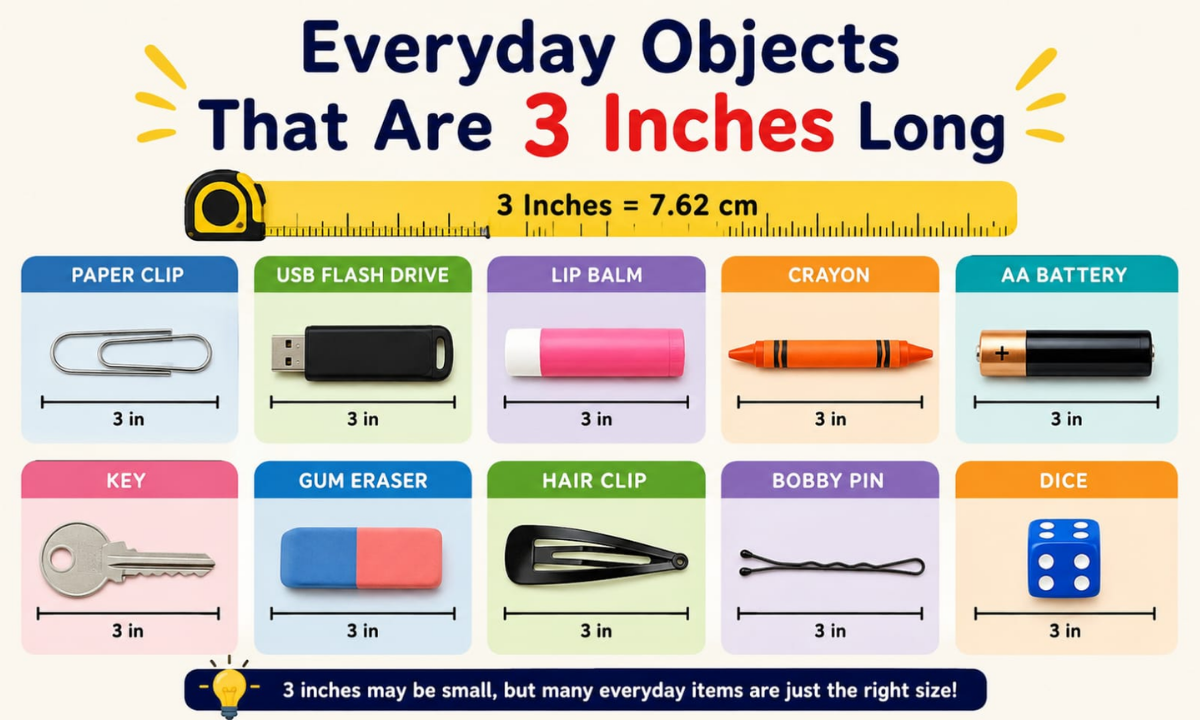
Three inches is a small measurement, but it can be surprisingly difficult to picture without a ruler. Knowing what 3 inches looks like can help when you are shopping online, working on a craft project, checking the size of an item, or estimating a measurement around the house.
Exactly 3 inches equals 7.62 centimeters, 76.2 millimeters, or one-quarter of a foot. Because many everyday objects are close to this size, you can use familiar items as quick visual references. Keep in mind that most natural or manufactured objects vary slightly, so these comparisons are best for estimation rather than precision work.
Why Understanding 3 Inches Matters
Understanding 3 inches gives you a useful mental reference for small measurements. You may encounter this length in product dimensions, hardware, stationery, food items, electronics, and household objects.
A ruler is always the best choice when accuracy is important, but familiar objects can make estimating easier. For example, a standard 3 × 3-inch sticky note provides a particularly useful reference because its dimensions are standardized.
Knowing this measurement can help with:
- DIY and home improvement projects
- Crafting and school projects
- Shopping for small products
- Checking whether an object will fit in a particular space
- Estimating dimensions when a ruler is unavailable
How Long Is 3 Inches?
Three inches is exactly 7.62 cm. On a standard ruler, it is the distance between the zero mark and the 3-inch mark.
| Measurement | Equivalent to 3 Inches |
| Inches | 3 inches |
| Centimeters | 7.62 cm |
| Millimeters | 76.2 mm |
| Feet | 0.25 ft |
| Yards | 0.0833 yd |
| Meters | 0.0762 m |
A simple way to remember it is:
3 inches = 7.62 centimeters = 76.2 millimeters
Three inches is also one-quarter of a foot, which can make the measurement easier to understand when comparing larger dimensions.
1. A Standard Business Card (Longest Side)

A standard business card is usually around 3.5 inches long and 2 inches wide, depending on the country and card format. Its longer side is therefore slightly longer than 3 inches.
If you need to visualize 3 inches, imagine a line that is a little shorter than the long edge of a typical business card. This makes a business card a useful approximate reference, but not an exact 3-inch object.
Because business cards are common in wallets, offices, and bags, they can be convenient for quick visual comparisons.
2. A Large Strawberry

A particularly large strawberry can reach close to 3 inches in length, although most strawberries are considerably smaller.
This is a natural example rather than a standardized measurement. Strawberry varieties, growing conditions, and ripeness all affect their size.
If you are trying to visualize 3 inches, imagine a large strawberry extending from its leafy top to its bottom tip. It can provide a rough reference, but you should not use it for precise measurements.
3. An Adult Male Thumb

An adult thumb can be approximately 2.5 to 3 inches long, depending on the individual’s hand size.
The distance is generally considered from the base of the thumb to its tip. Since human body measurements vary significantly, your own thumb may be shorter or longer than 3 inches.
Still, it can be a convenient personal measuring reference when you need to estimate a short distance quickly.
For accurate work, measure your thumb once with a ruler and remember its approximate length. Then you will know whether your own thumb is a good 3-inch reference.
4. A Wallet Width

A wallet can provide a useful comparison for understanding 3 inches, particularly when considering the width of compact wallets or individual sections inside them.
However, wallets are available in many shapes and sizes, so their overall width is not standardized at exactly 3 inches. A traditional wallet may be wider than 3 inches when opened or closed.
For visualization, imagine a section of a wallet that is approximately 3 inches across. It gives you a familiar everyday reference without suggesting that every wallet has the same dimensions.
5. A Wine Cork

Wine corks can provide a rough reference for 3 inches when comparing one or more corks together. Individual corks vary considerably in length, with many common wine corks being shorter than 3 inches.
Two corks placed end-to-end can therefore create a combined length that approaches 3 inches, depending on their individual sizes.
This example is particularly useful because corks are compact and cylindrical, making them easy to line up for a quick visual comparison.
6. A Chain of Paper Clips

Paper clips are another convenient way to visualize a 3-inch length. Several small paper clips linked together can create a line close to 3 inches.
The exact number depends on the type and size of the paper clips. Larger clips may require fewer pieces, while small clips require more.
For a quick demonstration, place paper clips end-to-end on a flat surface and compare the resulting chain with a ruler. This can help you develop a better sense of what 3 inches looks like.
7. A Medium Binder Clip

A medium binder clip is generally smaller than 3 inches in its closed form, but its opened handles or overall span can provide a useful visual comparison.
Binder clips come in several sizes, so there is no single standard measurement that applies to every medium clip. Some larger clips may approach the 3-inch range in one dimension.
If you are using one as a reference, measure the particular binder clip you have rather than assuming every medium binder clip is 3 inches.
8. A Smartphone Width

Some compact smartphones and older phone models have widths close to 3 inches, making them familiar technology-based references.
Modern smartphones vary considerably in width. Many current devices are wider or narrower than exactly 3 inches, so a phone should be treated as an approximate comparison.
The easiest way to use a smartphone as a visual reference is to imagine a 3-inch line across its width. If your phone is close to that measurement, it can help you picture the size quickly.
Read This: Monster Can Dimensions: Standard Sizes, Measurements & Variants
9. A Golf Tee

A standard golf tee can be close to 3 inches long, although golf tees are manufactured in different sizes.
Many tees fall around the 2.75-to-3.25-inch range, making a 3-inch tee a convenient visual reference. Unlike objects such as strawberries or thumbs, golf tees are manufactured products, so their dimensions are more consistent.
If you have a golf tee available, place it beside a ruler and identify the 3-inch point. This gives you a practical reference that you can remember later.
Other Things Close to 3 Inches
Several other everyday objects can help you visualize a 3-inch length. Their exact dimensions vary, so consider them reference points rather than measuring tools.
| Object | Approximate Relationship to 3 Inches |
| 3 × 3-inch sticky note | Exactly 3 inches on each side |
| Lip balm tube | Often close to 3 inches tall |
| Standard crayon | Often around 3 inches when new |
| House key | Many are close to 3 inches long |
| Golf tee | Some are close to 3 inches |
| USB flash drive | Some models approach 3 inches |
| 3-inch nail | Exactly 3 inches by specification |
| Hockey puck | 3 inches in diameter |
| Large paper clip | Can approach 3 inches when straightened |
| Small pocket comb | Some models are close to 3 inches |
One particularly useful exact reference is a 3-inch construction nail, provided the product is actually specified as 3 inches. A regulation hockey puck is another useful comparison because its diameter is standardized at 3 inches.
How to Measure 3 Inches Without a Ruler
You can estimate 3 inches by comparing the target with a familiar object, but the accuracy depends on the reference.
Try these methods:
- Use a 3 × 3-inch sticky note: One side is exactly 3 inches.
- Use a known 3-inch object: A correctly labeled 3-inch nail can provide a fixed reference.
- Compare with your hand: If you know your thumb or finger measurement, use it as a personal reference.
- Line up small objects: Several coins, clips, or other objects can be arranged end-to-end.
- Use your phone: If you know your phone’s actual width, it can serve as a convenient comparison.
These methods work well for rough estimates. They should not replace a ruler or measuring tape when precise dimensions are required.
Using Three-Inch References Around the House
Three-inch references can be surprisingly useful in everyday situations. You may not always need an exact measurement; sometimes you simply need to know whether something is roughly the right size.
Home Improvement
A quick 3-inch reference can help when estimating small gaps, hardware, trim pieces, or spacing before taking an accurate measurement.
Interior Design
When arranging small decorations, frames, shelves, or accessories, visualizing 3 inches can help you judge spacing.
Gardening
Three inches can be useful when estimating shallow planting depths, small gaps, or the size of gardening accessories. Exact planting instructions should always take priority over visual estimates.
Craft Projects
Crafting often involves small measurements. A familiar 3-inch reference can help when cutting paper, fabric, ribbon, or other materials.
Shopping Online
Product descriptions frequently list dimensions in inches. Knowing what 3 inches looks like can make it easier to judge whether a small item will fit inside a drawer, bag, container, or storage space.
Why Approximate Measurements Are Good Enough
Approximate measurements are useful when the goal is simply to visualize size. If someone tells you an object is about 3 inches long, you can quickly understand that it is compact and roughly 7.62 cm in length.
However, approximation becomes risky when even a small difference matters. A 3-inch object and a 3.5-inch object may look similar, but the difference can be important when checking whether something fits into a specific space.
Use everyday references for estimation, then switch to a proper measuring instrument when precision matters.
A good rule is simple:
Estimate with familiar objects, but verify with a ruler or tape measure before making an exact cut, purchase, installation, or measurement.
Conclusion
Three inches equals 7.62 centimeters, and it is small enough to appear in many everyday objects. Business cards, large strawberries, thumbs, wallets, paper clips, binder clips, smartphones, and golf tees can all help you build a mental picture of this measurement, although most are approximate rather than exact.
The easiest way to understand 3 inches is to combine several familiar references with one standardized object. A 3 × 3-inch sticky note or a properly specified 3-inch item gives you a dependable starting point, while everyday objects make the measurement easier to visualize.
Once you become familiar with 3 inches, estimating small dimensions becomes much easier. Just remember that visual comparisons are for quick estimates, while a ruler, measuring tape, or caliper is the better choice whenever accuracy matters.
Frequently Asked Questions
How many centimeters are 3 inches?
Three inches equals exactly 7.62 centimeters or 76.2 millimeters.
Is 3 inches the same as 7.5 cm?
Not exactly. Three inches is 7.62 cm, which is slightly longer than 7.5 cm.
Can a thumb be 3 inches long?
Yes. Some adult thumbs measure close to 3 inches, but hand and thumb sizes vary from person to person.
Is a golf tee 3 inches long?
Some standard golf tees are close to 3 inches, although available tee sizes commonly vary around that measurement.
What household item is exactly 3 inches?
A standard 3 × 3-inch sticky note is exactly 3 inches on each side, making it one of the simplest household references.
How can I measure 3 inches without a ruler?
Use a known 3-inch reference such as a 3-inch nail or sticky note, or compare the distance with a familiar object whose dimensions you already know.
Is a smartphone 3 inches wide?
Some smartphones are close to 3 inches wide, but modern phone dimensions vary, so check the specific model for an accurate measurement.
Why is it difficult to visualize 3 inches?
People are generally better at recognizing familiar objects than abstract measurements, which is why comparing 3 inches with everyday items makes the size easier to understand.

Eliana is an English language writer with 10 years of experience. She creates simple grammar guides, vocabulary tips, and writing resources for GrammerMint readers.