

Many people are unsure whether they should write company wide, companywide, or company wide in business emails, reports, and workplace documents. Since all three forms appear online, it is easy to become confused about which spelling is the most accurate and professional.
The good news is that the difference is mostly about writing style rather than meaning. Companywide is the preferred spelling in most modern dictionaries and business writing, while company wide is still accepted in some contexts.
Company-wide with a hyphen is often used before a noun as a compound adjective. This guide explains the differences, grammar rules, examples, and common mistakes.
Quick Answer
If you need a quick answer, companywide is the preferred spelling in modern English. It is widely accepted in business communication, dictionaries, and many style guides.
The hyphenated form company-wide is commonly used when it comes before a noun, while the open form company wide appears less often and is generally considered the least preferred spelling.
For most professional writing, choosing companywide is the safest option.
What “Companywide” Means?
The word companywide means affecting, including, or applying to the entire company. It describes something that involves every department, employee, office, or business unit rather than a single team.
The term is commonly used in business communication because it clearly shows that an action or decision applies to the whole organization.
Examples:
- The companywide meeting begins at 10 a.m.
- Management announced a companywide salary review.
- The companywide training program starts next week.
- Employees received a companywide email.
In each sentence, the action applies to the entire company.
Why Are There Multiple Spellings?
English changes over time, and compound words often move through different stages before one spelling becomes standard.
Many compound words begin as two separate words, later become hyphenated, and eventually appear as one word. Examples include website, email, and notebook.
The same pattern explains why you may see:
- Company wide
- Company-wide
- Companywide
Although all three forms appear in published writing, companywide has become the most common modern spelling.
Company-Wide vs Companywide: Key Difference
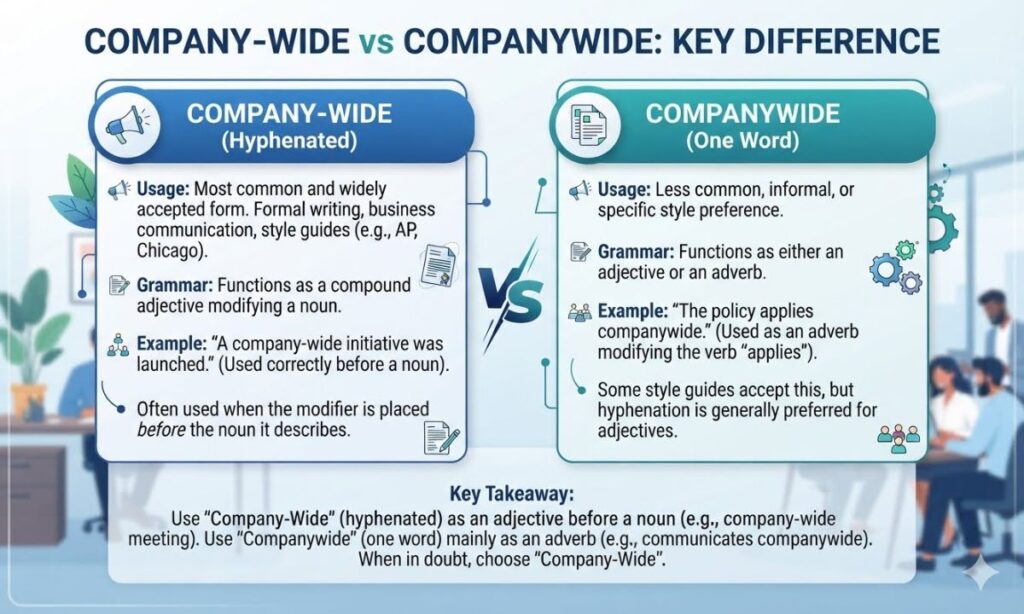
The meaning of both forms is exactly the same. The only difference is spelling and style.
| Companywide | Company-Wide |
| One word | Hyphenated |
| Preferred in modern dictionaries | Often used before nouns |
| Common in business writing | Common in edited publications |
| Modern style | Traditional style |
Neither spelling changes the meaning of the sentence.
Style Guide Comparison (AP, Chicago, APA)
Different writing styles sometimes prefer different spellings.
| Style Guide | Preferred Form |
| AP Style | Companywide is generally preferred, although hyphenation may appear for clarity. |
| Chicago Manual of Style | Companywide is commonly accepted unless clarity requires a hyphen. |
| APA Style | Companywide is acceptable as a closed compound word. |
Although individual organizations may have their own preferences, companywide is becoming the standard choice.
Which Spelling Should You Use?
If you are writing business emails, reports, website content, articles, or professional documents, use companywide.
Use company-wide only when your organization follows a style guide that prefers hyphenated compound adjectives or when the hyphen improves readability.
The open form company wide is much less common and is usually avoided in formal writing.
Real World Examples
Here are some examples taken from everyday business situations.
- The CEO announced a companywide restructuring.
- We introduced a companywide security policy.
- Employees attended a companywide meeting.
- The company launched a companywide wellness program.
- A companywide survey will begin next Monday.
These examples show how naturally the word fits into workplace communication.
Is There a Meaning Difference?
No. Companywide, company-wide, and company wide all express the same basic meaning.
Each form describes something that affects the entire company.
The difference is based on spelling preference and editorial style rather than grammar or meaning.
Why “Companywide” Is Becoming More Common
Modern English often combines frequently used expressions into single words.
As businesses rely more on digital communication, shorter spellings become easier to read and type. Dictionaries and publishers have gradually accepted companywide because it reflects current writing habits.
Many businesses now use companywide in:
- Employee handbooks
- Company websites
- HR documents
- Internal emails
- Policy manuals
- Corporate announcements
This growing usage has helped make the closed form more popular.
Common Usage Contexts
The word companywide appears in many workplace situations.
Some common examples include:
- Companywide announcements
- Companywide meetings
- Companywide policies
- Companywide training
- Companywide surveys
- Companywide updates
- Companywide events
- Companywide initiatives
It is one of the most frequently used compound words in business English.
Hyphenation Rule: Company-Wide vs Companywide
Hyphenation depends mainly on style rather than grammar.
Many editors use company-wide before a noun because the hyphen makes the compound adjective easier to read.
Examples:
- A company-wide policy
- A company-wide initiative
- A company-wide announcement
When the word stands alone or follows the noun, many writers prefer the closed form.
Examples:
- The policy is companywide.
- The announcement was companywide.
Today, many organizations simply use companywide in both positions.
How to Use Companywide Correctly in Sentences
The word companywide can function as both an adjective and, in some contexts, as a predicate adjective.
Examples:
- The companywide training begins tomorrow.
- We introduced companywide safety standards.
- The changes were companywide.
- Management approved a companywide hiring plan.
- Employees received companywide updates.
Using the word correctly helps make business writing concise and professional.
Business Writing Examples
The following examples show how companywide is commonly used in professional communication.
- A companywide meeting has been scheduled for Friday.
- We are launching a companywide customer service initiative.
- The companywide policy takes effect next month.
- Employees completed the companywide survey.
- Management announced companywide performance bonuses.
These examples reflect real workplace language.
Companywide Usage Tips
To choose the correct spelling more easily, remember these simple guidelines.
- Use companywide in most modern business writing.
- Use company-wide only if your organization’s style guide prefers hyphenation.
- Avoid company wide unless you are following a specific editorial style that allows the open form.
Following one style consistently makes your writing look more professional.
Common Mistakes
Many writers make the same mistakes when using this word.
Some common errors include:
- Mixing different spellings in the same document.
- Writing company wide without following a style guide.
- Adding unnecessary hyphens.
- Changing the spelling halfway through an article.
Choose one preferred spelling and use it consistently.
Incorrect Usage
Incorrect
- The company wide meeting starts tomorrow.
- We announced a company wide policy.
- Our company wide email was sent yesterday.
Better
- The companywide meeting starts tomorrow.
- We announced a companywide policy.
- Our companywide email was sent yesterday.
Frequently Asked Questions
Is companywide one word or two?
The preferred modern spelling is companywide as one word.
Is company-wide correct?
Yes. Company-wide is also correct and is commonly used before nouns in some style guides.
Is there a difference between companywide and company-wide?
No. Both have the same meaning. The difference is only in spelling and editorial style.
Should I use companywide in business writing?
Yes. Companywide is widely accepted and is the preferred spelling for most modern business documents.
Why do some companies still use company-wide?
Some organizations follow older editorial styles or internal writing guidelines that continue to recommend the hyphenated form.
Conclusion
The difference between companywide, company-wide, and company wide is mainly a matter of writing style. Companywide has become the preferred spelling in modern English because it is concise, widely accepted, and commonly used in business communication. Company-wide remains correct in many style guides, especially when used before a noun.
If you want clear, professional, and consistent writing, companywide is usually the best choice.

Eliana is an English language writer with 10 years of experience. She creates simple grammar guides, vocabulary tips, and writing resources for GrammerMint readers.