
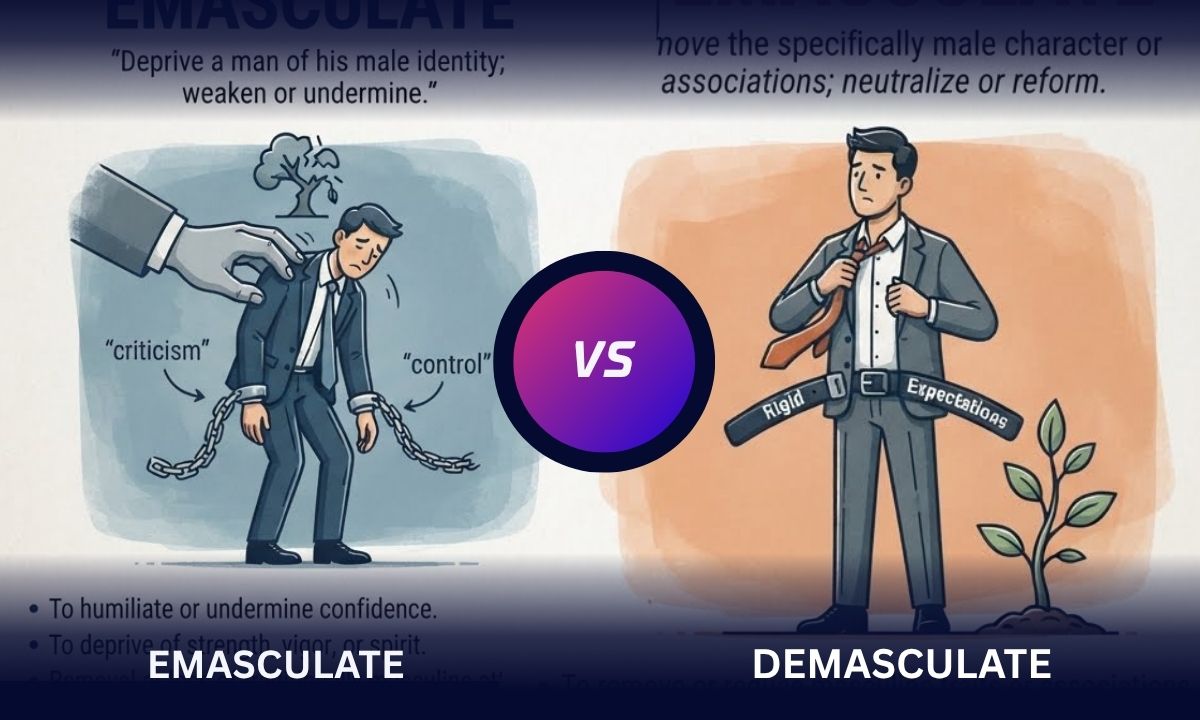
Many people get confused between emasculate and demasculate because both words sound similar. Some believe they have different meanings, while others think they can be used in the same way. In reality, only one of these words is accepted in standard English.
In this guide, you will learn the correct meaning of emasculate, whether demasculate is a real word, the differences between the two terms, proper sentence examples, and answers to common questions. By the end, you will know which word to use with confidence.
Understanding Emasculate: Definition and Proper Usage
Emasculate is the correct English word. It is a verb that has been used for centuries and appears in all major English dictionaries. Depending on the context, it has two common meanings.
The first meaning is historical or literal. It refers to castrating a male by removing the testes. Today, this meaning is mostly found in historical, legal, or medical discussions.
The second meaning is figurative and much more common in modern English. It means to weaken someone’s confidence, authority, strength, or traditional sense of masculinity. It can also describe making something less effective, less powerful, or less influential.
For example:
- Harsh criticism can emasculate a person’s confidence.
- The new policy emasculated the committee’s authority.
- He felt emasculated after constantly being ignored at work.
In modern writing, the figurative meaning is far more common than the literal one.
Verb Forms of Emasculate
Since emasculate is a regular verb, its forms are easy to remember.
| Verb Form | Example |
| Base Form | emasculate |
| Third Person Singular | emasculates |
| Present Participle | emasculating |
| Past Tense | emasculated |
| Past Participle | emasculated |
Examples:
- They often emasculate his ideas during meetings.
- The constant criticism is emasculating his confidence.
- The decision emasculated the manager’s authority.
- She believes the policy has emasculated the department.
These forms follow normal English grammar rules.
Demasculate: Does This Word Actually Exist?
The word demasculate is sometimes seen online, but it is not recognized as a standard English word by major dictionaries such as Oxford, Cambridge, Merriam Webster, or Collins.
Many people assume that adding the prefix de creates the opposite meaning, but this is not how the word developed in English. Historically and grammatically, emasculate already carries the intended meaning, so demasculate is unnecessary.
Most examples of demasculate appear because of:
- Confusion with other words beginning with de
- Typing mistakes
- Incorrect usage on social media
- Misunderstanding of English word formation
For professional, academic, or everyday writing, always choose emasculate.
Emasculate vs. Demasculate: Key Differences Explained

Although the words look similar, only one is accepted in standard English.
| Feature | Emasculate | Demasculate |
| Standard English word | ✅ Yes | ❌ No |
| Found in major dictionaries | ✅ Yes | ❌ No |
| Accepted in academic writing | ✅ Yes | ❌ No |
| Used in professional communication | ✅ Yes | ❌ No |
| Correct modern usage | ✅ Yes | ❌ No |
The difference is simple. Emasculate is the correct and recognized verb, while demasculate should be avoided because it is not considered standard English.
How to Use Emasculate Correctly in Sentences
The word emasculate can describe a person, an organization, a policy, an argument, or anything that loses strength, confidence, or authority. In modern English, it is usually used figuratively rather than literally.
Examples involving people:
- Public humiliation can emasculate someone’s confidence.
- He felt emasculated after being constantly ignored.
- The unfair criticism seemed to emasculate his self esteem.
Examples involving organizations or ideas:
- The new law emasculated the committee’s powers.
- Budget cuts emasculated the research project.
- The revised rules emasculated the effectiveness of the proposal.
When using this word, make sure the context clearly shows a loss of strength, authority, or confidence rather than physical harm.
Frequently Asked Questions
Is the word demasculate or emasculate?
The correct word is emasculate. Demasculate is not recognized as a standard English word and should not be used in formal writing.
What is the word for losing masculinity?
The verb emasculate is commonly used to describe reducing or undermining someone’s traditional sense of masculinity, confidence, or authority. The exact meaning depends on the context.
Is there a female version of emasculation?
There is no direct female equivalent that is used in the same way as emasculate. Depending on the context, writers may use words such as humiliate, disempower, undermine, or belittle instead.
What does emasculate someone mean?
To emasculate someone usually means to weaken their confidence, authority, or traditional sense of masculinity. In historical or medical contexts, it may refer to castration, but this usage is much less common today.
Can emasculate refer to things instead of people?
Yes. The word can describe laws, policies, organizations, plans, or arguments that become weaker or lose effectiveness.
Examples:
- The amendment emasculated the original proposal.
- Budget reductions emasculated the project’s impact.
Conclusion
The difference between emasculate and demasculate is straightforward. Emasculate is the correct English word and is accepted by all major dictionaries. It can describe reducing someone’s confidence, authority, or traditional sense of masculinity, and it may also refer to weakening the power or effectiveness of something.
Demasculate, on the other hand, is not considered standard English and should be avoided in professional, academic, and everyday writing. If you want your writing to be accurate and grammatically correct, always choose emasculate.

Eliana is an English language writer with 10 years of experience. She creates simple grammar guides, vocabulary tips, and writing resources for GrammerMint readers.