

Many English learners get confused between to fast and too fast because both phrases sound almost the same. However, they have completely different meanings. Using the wrong one can change the meaning of your sentence and make your writing unclear.
In this guide, you will learn the difference between to fast and too fast with simple explanations and easy examples. You will also discover common mistakes, practical tips, American and British English usage, and answers to the most common questions.
Contextual Examples
Simple Comparative Example
Use too fast when something happens at an excessive speed.
Examples
- The train was too fast to stop in time.
- You are walking too fast for me.
- The music is playing too fast.
Infinitive Confusion
Sometimes people mistakenly write to fast when they actually mean too fast.
Correct:
- He was driving too fast.
Correct infinitive use:
- The doctor asked him to fast before surgery.
Modifier Placement
The word too should come directly before the adjective or adverb it modifies.
Correct:
- She answered too fast.
Incorrect:
- She too answered fast. (Different meaning)
Adjective vs Adverb
Fast can be both an adjective and an adverb.
As an adjective:
- It is a fast computer.
As an adverb:
- The computer runs fast.
With too:
- The computer runs too fast.
Instructional Contrast
Compare these two sentences carefully.
- The nurse said to fast before the test.
- The patient was walking too fast.
The first sentence uses fast as a verb.
The second sentence uses fast as an adverb.
Common Mistakes
Mistake: Confusing To and Too
Many writers choose to because both words sound alike.
Incorrect:
- He drove to fast.
Correct:
- He drove too fast.
Mistake: Using To Fast When Meaning To Abstain Without Context
When using to fast, make sure the sentence clearly shows that fast means avoiding food.
Correct:
- She plans to fast during the religious event.
Unclear:
- She wants to fast tomorrow.
Adding context makes the meaning easier to understand.
Mistake: Splitting Too and Fast
Keep too fast together because too modifies fast.
Correct:
- The horse ran too fast.
Incorrect:
- The horse ran too quickly fast.
Mistake: Overusing Too Without Degree Limit
Use too only when something exceeds an acceptable limit.
Correct:
- The coffee is too hot to drink.
Better comparison:
- The coffee is very hot.
Mistake: Double Adverbs
Avoid unnecessary adverbs.
Incorrect:
- He drove too very fast.
Correct:
- He drove too fast.
American vs British English Differences
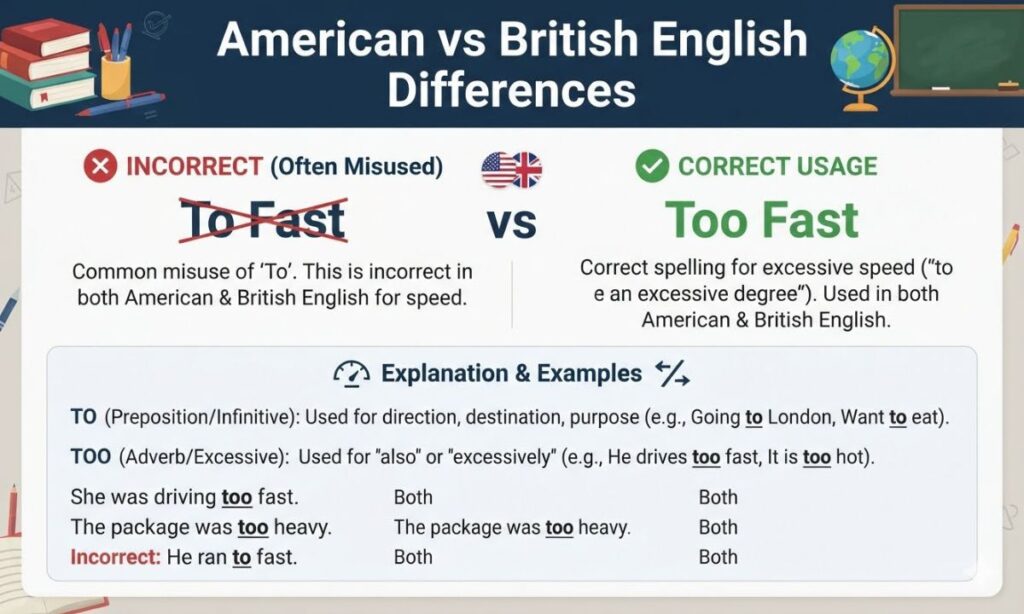
Core Rule Is Universal
Both American and British English follow the same grammar rule.
- Too fast means excessively fast.
- To fast means to avoid eating.
There is no spelling difference between the two varieties of English.
Subtle Usage Notes
American English may use fasting more often in medical instructions.
British English also uses fasting in healthcare and religious contexts.
The grammar remains exactly the same.
Verb Meanings And Context
The word fast has more than one meaning.
As a verb, it means to avoid food for a specific period.
As an adjective, it means quick.
As an adverb, it means quickly.
The surrounding words tell you which meaning is intended.
Idiomatic Expressions
Too Fast For Someone or Something
This phrase means someone cannot keep up.
Examples
- The lesson moved too fast for beginners.
- The game was too fast for the new players.
- The conversation became too fast for me.
Too Fast, Too Furious (Idiomatic Play)
People sometimes say too fast, too furious as a playful expression to describe something that is moving with excessive speed or energy. It is an informal phrase rather than a grammar rule.
To Fast As A Verb (Religious Or Medical Contexts)
The verb fast is commonly used in these situations.
Religious examples
- Many people choose to fast during Ramadan.
- Some Christians decide to fast before Easter.
Medical examples
- Patients may need to fast before surgery.
- The doctor asked him to fast for twelve hours.
Fixed Collocations With Too
Common expressions include:
- Too fast to stop
- Too fast to understand
- Too fast for me
- Too fast to react
- Too fast to notice
Practical Tips
Tip 1: Read For Meaning, Not Just Sound
Ask yourself whether you mean excessive speed or avoiding food.
Tip 2: Use Tests To Decide Between To and Too
Replace too with excessively.
If the sentence still makes sense, use too.
Example:
- He was excessively fast.
- He was too fast.
Tip 3: Keep Modifiers Next To What They Modify
Place too immediately before fast.
Correct:
- She talks too fast.
Tip 4: Avoid Redundancy With Degree Words
Do not combine several words that show degree unnecessarily.
Correct:
- The car is too fast.
Incorrect:
- The car is extremely too fast.
Tip 5: Clarify Ambiguous Infinitive Uses
When using to fast, include enough context.
Example:
- The doctor advised him to fast before the blood test.
Tip 6: Use Result Clauses To Show Consequence
Use too…to for natural English.
Examples:
- The soup is too hot to eat.
- He was driving too fast to stop safely.
Tip 7: Maintain Verb Tense And Agreement
Keep your verbs consistent.
Correct:
- She decided to fast yesterday.
- They are going to fast tomorrow.
Tip 8: Teach This Rule With Minimal Examples
Simple examples are easier to remember.
- He talks too fast.
- I need to fast.
Tip 9: Use Punctuation To Improve Clarity
Good punctuation makes long sentences easier to read.
Example:
- Before the operation, the doctor told him to fast.
Tip 10: Read Aloud For Naturalness
Reading your sentence aloud often helps you hear whether to or too is correct.
Frequently Asked Questions
Is it too fast or to fast?
Use too fast when something is excessively fast. Use to fast only when fast is a verb meaning to avoid food.
Why do people confuse to and too?
They sound the same in spoken English, so many writers accidentally choose the wrong spelling.
Can fast be both a verb and an adverb?
Yes. It can be a verb meaning to avoid food and an adverb meaning quickly.
Is to fast grammatically correct?
Yes. It is correct when to is part of an infinitive, such as to fast before surgery.
Does British English use different grammar for too fast?
No. American and British English use the same grammar rules.
Conclusion
The difference between to fast and too fast is simple once you know their meanings. Too fast describes something moving or happening more quickly than it should. To fast means to avoid eating for religious, medical, or personal reasons.
Always read the sentence carefully and think about the meaning before choosing the correct word. With regular practice, you will use both expressions confidently and accurately.

Eliana is an English language writer with 10 years of experience. She creates simple grammar guides, vocabulary tips, and writing resources for GrammerMint readers.